
-
Current Donation Goals
-
Forum DonationsRaised $2,461 of $7,500 target
-
-
To send a donation, just click on
FORUM DONATIONS in the box above. -
Recent Posts
-
-
By aznation · Posted
The Org or Routing Symbol beginning with AMXLE on DA Label 80 corresponds to the Letterkenny Army Depot in Chambersburg, PA. https://www.letterkenny.army.mil/1960/ 1960's Depot History Leterkenny Ordnance Depot was renamed Letterkenny Army Depot (LEAD) in August 1962, and command and control of the Depot fell under the U.S. Army Materiel Command. The war in Vietnam signified the 1960s. An increase in missions and workload arrived at the Depot. Letterkenny was affected in much the same way as the Korean War in that materiel beyond normal requirements was funneled through the supply system to the troops. Letterkenny again stood ready to support American forces and employment rose. The Depot Maintenance Division developed into one of the largest activities, employing 1,400 workers and reconditioning AA Artillery, combat vehicles and guided missiles. The ‘60s also brought automation to the Depot. During this time, construction to update many of the buildings and facilities was underway. In 1964, the 28th Ordnance Detachment relocated to Letterkenny from Fort Meade, Md. to dispose of explosive ordnance items such as bombs, shells, rockets, and guided missiles in addition to assisting police in the disposal of explosives and war souvenirs. -
-
-
By aznation · Posted
https://nsarchive.gwu.edu/briefing-book/intelligence/2023-03-13/whats-there-where-it-and-whats-it-doing-us-space-surveillance What’s Up There, Where Is It, and What’s It Doing? The U.S. Space Surveillance Network by James E. David and Charles Byvik The mission of the Department of Defense’s Space Surveillance Network is to detect, track, and identify all artificial objects orbiting the Earth and provide data on them to a range of users. Ground-based radars and telescopes, augmented in recent years by telescopes on a small number of satellites, acquire the raw data, which is then analyzed to determine specific information on each object detected and tracked. This information is used for a variety of purposes: to maintain unclassified and classified catalogs of all known space objects (U.S. and foreign active satellites and space debris); for Space Object Identification to determine the size, shape, and motion of satellites to assist in determining their missions; to support the targeting of anti-satellite weapons systems; to determine the arrival time of satellites over a certain point on Earth; to predict the decay of objects that enter into the Earth’s atmosphere and their impact point if they survive reentry; and to predict collisions of objects in space.[1] Although there are many gaps in the network’s history due to continuing classification, this briefing book describes the evolution of the Space Surveillance Network from the Sputnik era to the present, based on the available declassified materials and other sources. 1957-1970 The first U.S. assets specifically developed to conduct space surveillance were the large Baker-Nunn cameras built by the Smithsonian Astrophysical Observatory (SAO) to track and photograph U.S. scientific satellites scheduled for launch during the International Geophysical Year from July 1957 through the end of 1958. The SAO oversaw the building, deployment, and operation of these cameras at 12 fixed sites worldwide beginning in 1958 and, starting in 1957, the establishment of Moonwatch teams of amateur astronomers using small telescopes in the United States and abroad. Using information from the Moonwatch teams and other sources to determine where to point their cameras, the Baker-Nunn equipment could photograph satellites up to altitudes of 2,000 miles for a limited number of inclinations. Additionally, two worldwide networks of ground stations—with radars, antennas, and other equipment to track, receive telemetry from, and send commands to, U.S. scientific satellites—were established: the Naval Research Laboratory’s (NRL) Minitrack network for Vanguard satellites and the Jet Propulsion Laboratory’s Microlock network for Explorer satellites.[2] The performance of these and other assets was first tested when the Soviets launched Sputnik 1 into a low-Earth orbit (an altitude below 1,200 miles) on October 4, 1957. Moonwatch teams quickly obtained information on the orbit that enabled the NRL’s radio array in northern Virginia to acquire the satellite’s continuously transmitted signals beginning on its third orbit to help refine the orbital parameters. Tracking by these passive systems was augmented by several existing operational U.S. radar facilities around the world such as the Air Force radar at Diyarbakir, Turkey, used to detect and track Soviet missiles launched from Kapustin Yar, and selected radars at the Atlantic Missile Range. The Millstone Hill radar under development for the planned Ballistic Missile Early Warning System (BMEWS) by Lincoln Laboratory in Massachusetts was the first U.S. radar to both detect and track Sputnik 1. Both the Army’s Vanguard Computing Center and the Air Force’s Air Research and Development Command, under Project Harvest Moon, processed data collected by passive and active sensors at these civilian and military facilities to accurately predict current and future orbits. These detection, tracking, and processing assets were quickly exercised again in November with the launch of Sputnik 2 into the same orbit, the world’s second successful satellite. They monitored the new satellite until it reentered the Earth’s atmosphere in early 1958. Improvements in the collection and processing of data were made during the remainder of the decade that addressed some deficiencies. In 1958, the NRL began construction of the first station of the Naval Space Surveillance (NAVSPASUR) system. Completed early the next year, it had three transmitter and six receiver sites across the southern United States on the 33rd parallel and a control and computational center in Virginia. NAVSPASUR continuously transmitted signals straight up into space and could initially detect objects passing through the signals up to an altitude of 2,000 miles. The Air Force moved the Harvest Moon project to a new National Space Surveillance Control Center in 1958 and began expanding the capabilities for processing data. The next year, it initiated SPACETRACK, a program to deploy improved optical and radar sensors. One of the early actions taken was the acquisition of several Baker-Nunn cameras, the first of which was deployed in Norway in 1960.[3] The USSR launched more than 150 spacecraft in the following eight years, including photoreconnaissance satellites and spacecraft carrying cosmonauts beginning in 1961, weather satellites starting in 1964, and communication satellites beginning in 1965. Except for communications satellites placed in highly elliptical orbits—also called Molniya orbits—and probes exploring the Moon or planets, all were in low-Earth orbit.[4] The aggressive Soviet space program clearly presented a potential threat to U.S. national security. The shortcomings of the fragmented DoD space surveillance efforts for global coverage and timely response were addressed in November 1960 when Secretary of Defense Thomas S. Gates, Jr., assigned operational control of the newly designated Space Detection and Tracking System (SPADATS) to the North American Air Defense Command (NORAD). SPADATS included NAVSPASUR, SPACETRACK, and the National Space Surveillance Control Center (which would soon be renamed the SPADATS Center). NORAD quickly took steps to improve the collection and processing of data, such as procuring advanced computers for the SPADATS Center, integrating BMEWS and SPADATS, and initiating the design of a dedicated space surveillance radar for deployment at Eglin Air Force Base in Florida.[5] NORAD and NASA entered into an agreement in 1961 that detailed their respective responsibilities regarding space surveillance. Based on data from its own and other sensors, NORAD was to include information on all known objects in orbit in a classified space catalog, while NASA was to provide NORAD with all the tracking data its networks acquired on U.S. and foreign spacecraft. NASA would receive all unclassified information on U.S. and foreign spacecraft from NORAD and disseminate it publicly in a separate, unclassified, space catalog. NORAD would provide NASA with classified information when the latter demonstrated a “need to know.”[6] NORAD published an updated set of space surveillance requirements in early 1965 after extensive consultation with users of its data. The high-level Ad Hoc Working Group on Department of Defense Space Detection, Surveillance, Tracking and Data Processing, established by the Deputy Secretary of Defense the prior year, quickly reviewed the requirements as part of its comprehensive examination of the space surveillance program. Among other things, its lengthy March 1965 report gave a detailed analysis of the capabilities of SPADATS and other military and civilian sensors, as well as SPADATS computer processing and communications facilities. SPADATS had no dedicated radars yet and relied on the three BMEWS radars (in Alaska, Greenland, and the United Kingdom), the missile detection/space surveillance radar on Shemya Island in the Aleutians, the RCA radar at Moorestown, New Jersey, the Millstone radar in Massachusetts, and the Diyarbakir radar in Turkey. All these facilities conducted space surveillance as a secondary mission and had varying capabilities to detect objects, but between them they detected, within the first few orbits, most Soviet satellites and other objects up to altitudes of 2,900 miles that were at least one square meter in size and orbiting at inclinations of 45 degrees and higher. These radars and the SPADATS optical sensors provided a good tracking ability and could predict an orbit after 12 hours of tracking with an accuracy of roughly one mile. The radars and optical sensors also obtained good Space Object Identification information. NAVSPASUR detected within the first five or six orbits most Soviet satellites and other objects up to altitudes of 4,000 miles that were at least one square meter in size and orbiting at inclinations of 30 degrees and higher.[7] With respect to other military and civilian sensors, a major contributor in several areas was what the report designated the “Intelligence Network.” Although not described further because of higher classification, the “Intelligence Network” referred to the National Security Agency’s worldwide network of ground stations, aircraft, and ships, and Central Intelligence Agency ground stations in several countries, that intercepted telemetry from foreign missiles and spacecraft. Telemetry from these vehicles to ground stations contains information on vehicle performance or data the spacecraft is acquiring, such as photography from weather satellites. It also includes commands from ground stations to these vehicles. The intelligence obtained from the collection and analysis of telemetry was critical to determining the missions of foreign satellites. Certain radars of the “Intelligence Network” and its communications intercept facilities (which monitored launch complex and downrange tracking station traffic) provided alerts on impending launches and enabled faster detection of any payloads that achieved orbit. Lastly, the “Intelligence Network” acquired limited tracking information. Tracking data on DoD satellites came from the Satellite Control Facility and on NASA satellites from NASA networks. Additionally, the Royal Canadian Air Force Satellite Tracking Unit had several sensors that provided information.[8] The Ad Hoc Working Group also assessed the extent to which SPADATS met user needs. It predicted the arrival of satellites at a given position to better than plus or minus 15 seconds, which was acceptable to most users. SPADATS provided needed support to many military and NASA space programs, including locating malfunctioning objects, predicting the decay of objects of particular interest (e.g., Soviet satellites and rocket stages), and tracking U.S. reconnaissance satellites to assist the Satellite Control Facility. The ability to determine the orbital elements of Soviet satellites and obtain their radar signatures (from which estimates of their size, shape, stability, and orientation could be made) were important contributors to Space Object Identification. Precision tracking information provided by SPADATS was sufficient for the two operational anti-satellite systems (the Air Force’s nuclear-armed Thor missiles on Johnson Atoll and the Army’s nuclear-armed Nike-Zeus missiles on Kwajalein Atoll) to be able to intercept a limited number of spacecraft in low-Earth orbit.[9] Although the Ad Hoc Working Group agreed with many of NORAD’s new requirements, it recommended disapproval based on technology availability, realistic future needs, and costs. Most significantly, the Working Group believed there was no justification for the technological improvements envisioned by 1970 (to extend altitude coverage to 23,000 miles, to increase the detection capability to objects 0.1 square meter in size without regard to altitude, and to improve the detection probability to 95 per cent for all objects before completion of their first orbit without regard to inclinations or altitude). The Deputy Secretary of Defense approved the Ad Hoc Working Group’s report and directed the Joint Chiefs of Staff to have NORAD revise the requirements to conform with it. The new set was approved by the Joint Chiefs of Staff and the Office of the Secretary of Defense in 1966.[10] One of the major challenges SPADATS faced was the rising number of spacecraft and the increasing amount of debris in orbit. From January 1967 to June 1969, for example, the USSR launched almost 200 spacecraft and the United States about 85. Almost all were in low-Earth orbit, except for probes, human spaceflight missions to the Moon, Soviet communications satellites, U.S. communications satellites in geosynchronous orbit (22,236 miles above the equator), and U.S. early warning satellites in medium-Earth orbit (an altitude between 1,200 and 22,236 miles). The number of publicly reported tracked objects increased from around 100 in 1961 to over 2,000 by the end of the decade. Although posing little threat to active satellites, there were increasing amounts of space debris in low-Earth orbit, and more of the debris in the lower regions of that orbit (up to 300 miles altitude) was surviving reentry and impacting on land or in the oceans, generating growing public concern about the possibility of damage or injury caused by objects falling from space. (Debris in the upper regions of low-Earth orbit remains in space for hundreds of years, while debris in medium-Earth and geosynchronous orbits can remain there for thousands of years.)[11] U.S. intelligence agencies were eager to collect the debris left behind by Soviet rockets, missiles, and satellites for analysis. Similarly, they wished to keep U.S. debris (particularly from missiles and classified U.S. satellites) out of Soviet hands to prevent their exploitation. To enable operational commands to take passive defensive action against Soviet photoreconnaissance satellites (such as moving their forces or using camouflage), the Defense Intelligence Agency and the Air Force’s Foreign Technology Division established the Satellite Reconnaissance Advanced Notice Program in late 1965. The system provided data to commands on the orbital elements, swath, and resolution of the satellites, and information on how to predict when they would be overhead. Testing of Soviet offensive space weapons began in 1966 with a fractional orbital bombardment system, a missile-launched nuclear weapons delivery system that flew a sub-orbital path. This system became operational in 1968 but was decommissioned in the early 1980s. The USSR also first successfully tested a co-orbital anti-satellite weapon in 1967. These exploded within 60 feet of the target satellite, releasing shrapnel to destroy it.[12] SPADATS increased its capabilities in several areas during the remainder of the decade. The SPADATS Center moved to the command’s new underground facility at Cheyenne Mountain in Colorado, procuring improved computer capability and upgrading communications with the sensor sites. Modifications to NAVSPASUR in 1966 increased the detection coverage to 6,000 miles, more than double any other SPADATS sensor. The first phased-array (electronic-steered) space surveillance radar, the AN/FPS-85, began operations at Eglin Air Force Base in Florida in 1969. It was the first sensor with the capability to provide detection and tracking coverage above 6,000 miles, extend surveillance to objects with orbital inclinations below 30 degrees, and simultaneously track multiple objects (200 known objects or 20 unknown objects). The AN/FPS-85 soon was able to identify numerous unknown objects which had been detected but not tracked. The ARPA Lincoln C-Band Observables Radar on Kwajalein entered service in 1969 to image objects in support of the Space Object Identification mission. Two Baker-Nunn cameras were moved to other nations, and all received upgrades that reduced from 24 to 12 hours the amount of time needed to search, locate, and produce an accurate observation of an object, and report the data to the Space Defense Center.[13] -

By Treeman434 · Posted
Found at an antique market, the buttons are throwing me off a bit. Looks like someone took a marker to make new chevrons on the shoulders but lots of older writing inside. -
By M422A1 · Posted
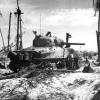
I started doing WWII re-enacting in the 70’s with the WWII Historical Re-enactment Society. And continued up through the 80’s. I was a German, in the 1st SS. Very little reproduction stuff was available back then. A lot of us converted 1950’s USMC wool dress uniforms into German uniforms. Most of the field gear we used was original. The U.S. guys had it much easier and cheaper. Most of what they needed was still available at your local Army-Navy store. And George Petersen showed up at most events with lots of stuff for sale at great prices. Fun times, but expensive for a poor college student like me. I need to digitize my photos from back then, I took pictures at all the events. -

By Bigrob1911 · Posted
Thank you Mr. Flick!! Once again, you are a fountain of wisdom!! -

By Shanny1298 · Posted
For reference, I purchased it for $50. Nice catch or a stinker? Lol -

By Charlie Flick · Posted
Very cool item, and one that I had not heard of before. Thanks for the education. Charlie
-
-

-

-
-

-
-
.jpg.2ce6a8d90c750304bcf9d4faa9318f5d.jpg.5a23d93005bf9ba70918d137e8d2e4fc.jpg)
-

-
-

-

-

-

-
* While this forum is partially supported by our advertisers, we make no claim nor endorsement of authenticity of the products which these advertisers sell. If you have an issue with any advertiser, please take it up with them and not with the owner or staff of this forum.