
-
Current Donation Goals
-
Forum DonationsRaised $2,461 of $7,500 target
-
-
To send a donation, just click on
FORUM DONATIONS in the box above. -
Recent Posts
-
By Shanny1298 · Posted
Another one for the experts here! It’s listed at a REALLY low price IMO, so if it’s genuine, I’m going to snatch it up. It has 10 feathers, not 9, but that’s obviously one small factor. If ya’ll think it’s good, I’ll ask for some black light photos just in case! Thanks! Shannon 🫡🪖 -
By cwnorma · Posted
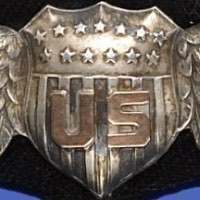
None that I've ever been able to find. But, the reciprocal is true as well. Clearly though, with respect to WW1 wings there was both copying of designs between competing firms (see: Dallas wings) and evolutionary change within lines (see: Simmang). As to Shreeve defending its Intellectual Property, the United States was a very different landscape in 1918. The badges themselves were only worn for a brief 18 months. My current theory (based admittedly on extremely limited [and mostly anecdotal] information is the solid version was a direct copy of the Shreve made by one of the Los Angeles based makers. If that tenuous theory holds, unless a cognizant employee decided to take the train down to LA from SF to check out the competition, how would Shreve have even known? Moreover, even if SF-based Shreve was aware of the copies, could they have mounted an IP challenge before the Adams wings hit the scene in 1919? (see Dallas wing patent fight) Besides all the physical differences possibly arguing for separate makers; the hollow version almost always is found bearing Shreve's hallmark. To date, none of the solid versions has surfaced with such a mark. Probative? Absence of evidence is not evidence. Adding to the challenge is that both the Shreve-marked hollow badge and the sterling marked solid badge are both so scarce that it is maddeningly challenging to find any information on either. Shreve is known to have made two WW1 era wing badges: 1) 1918 US Army Air Service Reserve Military Aviator, & 2) 1919 Philippine Air Service Aviator (phenomenally rare). Both 1) and 2) share Shreve's hollow construction and Hallmarks. The 3) solid badge remains an interesting, unresolved mystery: Ultimately all are different enough that every collector should strive to have one of each! Warm Regards! Chris -

By Meridian · Posted
Puzzle: Why Did Eisenhower Prefer Monty Over Patton? There is no doubt that General Eisenhower was the most important American military figure in World War II, while General Marshall mostly worked behind the scenes. As Supreme Commander of the Western Allied armies in Europe, he led the Allies to victory in the European theater — at least from the Western perspective. He undoubtedly deserved the glory and fame that came with that great achievement. No doubt? Actually, there is doubt. Most, if not all, British historians and online commentators blame his broad-front strategy for prolonging the war by six months. I do not think this criticism is entirely fair, because he never had enough material resources for a true broad-front offensive until very late. He repeatedly had to make difficult choices about which direction, which front, and which armies would receive priority for supplies. Resources played a major role in shaping military campaigns. It seems he consistently assigned the British general the leading role and gave his army priority of supply. British commentators should not claim this was how he prolonged the war — though in my humble opinion, this approach did prolong the war by about six months. Obviously, this British general refers to the most renowned Montgomery. His forces included both British and Canadian armies. From now on in this article, “British” will mean both British and Canadian. For a long time, I was puzzled why Eisenhower, as Supreme Commander of the Western Allied forces, always assigned the British the major roles in virtually all major campaigns. 1. Sicily Campaign The Sicily map looks like an upside-down triangle. Patton suggested that the British land in the middle of the east coast and attack Messina from the south, while the Americans landed at the western tip near Palermo and attacked Messina from the west. This plan made sense. However, the final plan was Montgomery’s: the British would take the only major offensive role, while the Americans, landing nearby, would play a merely supporting role to protect the British left flank. This placed the American forces in an awkward position — a large attachment that lost its initiative and maneuverability. Using a major battle force of roughly equal size in such a limited way could hardly be justified as military necessity; it felt more like contempt for American fighting capability. Of course, the plan was officially issued in the name of the campaign commander, British General Harold Alexander, but without the backing of his boss Eisenhower, it could not have been adopted. Eisenhower’s attitude toward his own troops cannot be explained by claiming the GIs were still too green. By the late North African campaign, American troops under Patton had already shown they were no longer the same force as during the Kasserine Pass debacle. The Sicily campaign did not unfold according to Montgomery’s carefully prepared military plan. The British quickly ran into serious trouble. Although the landing achieved tactical surprise, their thorough but slow preparation for the northward advance gave the Germans time to build strong defenses. The British had to fight inch by inch through heavily defended mountainous terrain, where heavy losses were inevitable. They advanced as slowly as snails. Meanwhile, Patton, frustrated with an entire army doing nothing but enduring German shelling, broke away from the stalemate and quietly executed his original plan. The result is well known. Most importantly, it demonstrated that the American army under Patton was far more effective than its British counterpart. The reward Patton received from Eisenhower was not praise, but something quite different. 2. Normandy Campaign By 1944 in the Western European theater, the situation had fundamentally changed. The Supreme Commander was American, America provided roughly 80% of the material and 60% of the troops. Nevertheless, the American Supreme Commander Eisenhower chose the British general Montgomery — who was not particularly renowned for military genius — to draw up the battle plan, while completely excluding his own most battle-proven general from the planning table. Montgomery’s Normandy plan was essentially a copy of Sicily. The British were to play the major offensive role, while the Americans protected the right flank and rear of the British advance. The development of the Normandy campaign also mirrored Sicily. The British offensive stalled almost immediately. What was supposed to be a one-day capture of Caen turned into a 50-day stalemate. The difference this time was that Montgomery eventually allowed the Americans to break through on their own. What followed is well known. 3. Market Garden Campaign At the end of August 1944, Patton was in the best position among the Allies to strike into Germany. He had reached the Siegfried Line, which was virtually undefended at the time. Between him and Berlin lay open German countryside with few major cities. The only significant obstacle was the Rhine River, which, as events later proved, could be crossed relatively easily. However, Eisenhower stopped Patton at this critical moment by diverting resources to Market Garden. Montgomery’s bold plan aimed to seize a series of bridges to thrust into the Ruhr area. The plan was obviously very risky. Using a huge airborne force to capture and hold objectives so far ahead had never been tested before. Even if Market Garden had succeeded, the Ruhr — a cluster of heavily industrialized cities — would have taken months to conquer and was not the best starting point for the conquest of Germany. Nevertheless, Eisenhower once again assigned Montgomery the main axis of advance into Germany over Patton. The result is also well known. 4. Crossing the Rhine In mid-February 1945, after defeating the Germans in the Bulge campaign, all Allied armies were positioned to cross the Rhine. Despite just almost falling out due to Montgomery claiming he saved US in the Bulge Campaign, once again, Eisenhower allocated the major bulk of resources — air cover, artillery, and a large airborne operation — to the British and their American attachments, while Patton’s Third Army was largely left to its own devices. This suggested Eisenhower had no real plan for Patton’s crossing and did not expect much from it. The results could not have been more ironic. Against all expectations, Patton’s DIY crossing succeeded with only about 30 casualties — half a day ahead of the heavily prepared British crossing, which, despite a month of preparation and massive resources, still suffered around 5,000 casualties. Why did Eisenhower always give the British the major role — and with it, the potential glory — without showing fairness or balance? The way Eisenhower treated one British general and one American general, both with large egos, could not have been more different. To Montgomery, he adopted his plans, prioritized his supplies, and let his troops play the leading offensive roles. To Patton, he humiliated him, demoted him, sidelined him, and restricted him. Most people explain this by saying that Eisenhower, as Supreme Commander of the entire Allied force, had to hold the alliance together — especially with the difficult and egotistical British general Montgomery. I do not think this is the full story. The person who desperately needed to hold the alliance together was Winston Churchill, because the alliance was essential to Britain’s survival. In Churchill’s eyes, any British general — even Montgomery — was expendable compared to billions of dollars in American weapons and millions of American soldiers. Beneath the diplomatic language of “holding the alliance together,” something more fundamental was at work in Eisenhower’s mind: casualties — specifically American casualties — and his own political survival. Unlike in other countries, the American public does not particularly admire generals who win glory at a high cost in American lives, especially in foreign wars. The European theater of World War II was a foreign war. As Eisenhower himself noted, many GIs in Europe did not even know what they were fighting for. Eisenhower understood that with the Red Army advancing from the east and the British and Americans from the west, the war against Nazi Germany would be won regardless. As Supreme Commander of the Western Allies, his fame and historical position as a war-winning leader were largely assured. His major concern was minimizing the cost in young American lives — the issue on which he would be most heavily scrutinized by the American media. If destroying Nazi Germany required a great deal of blood, he was determined that American blood should be kept to a minimum. To achieve this, he resolved to place American troops in a secondary line of fire, with the British army bearing the brunt of the fighting on the front line. Even the idea that the Supreme Commander of an Allied force would deliberately preserve his own troops while sacrificing others would have been extremely damaging to the alliance. Help came from the British themselves — specifically from Montgomery. He viewed American troops as green, American generals as unprofessional, and even his rival Patton as little more than a reckless cowboy. In contrast, he saw himself as the most professional military leader and the British army as the finest fighting force among the Allies. He believed British forces should occupy the center of the stage, with all the limelight and glory. For Eisenhower, nothing could have been better: you, not me, are demanding to be sent to the front line? Fine — I will fulfill your desire. To achieve his goal of preserving American lives, Eisenhower treated Patton most unfairly — even brutally. They had been friends before the war. Eisenhower knew Patton’s greatest weakness: his overwhelming desire to fight the war, which he saw as his destiny, at any cost — including swallowing humiliation. This weakness gave Eisenhower leverage over him. Many argue that Eisenhower saved Patton from being sent home after the slapping incidents. In reality, Eisenhower took full advantage of the event. Slapping soldiers sounds terrible, but in the context of a fighting army in wartime, it was understandable. Even though the U.S. media created a storm, there was no strong pressure from the Roosevelt administration or senior military leadership to punish Patton. As Patton’s superior, Eisenhower could have defended or excused the incidents as wartime necessity. Instead, he wrote to Marshall in a way that suggested he wanted to send Patton home. Marshall’s reply made it clear that Patton’s fate was in Eisenhower’s hands, but he also emphasized that Patton was a highly capable and irreplaceable general — clearly opposing the idea of sending him home. Did Eisenhower really consider sending Patton home? Of course not. He knew better than anyone how important Patton was to the war effort — and to himself. However, despite Patton’s success in Sicily, Eisenhower was deeply unhappy with his behavior — not primarily because of the slapping, but because of Patton’s refusal to accept an auxiliary role and his insubordination. By making a show of considering sending Patton home, Eisenhower gained Marshall’s permission to handle Patton as he wished. He ordered Patton to apologize publicly not just to the two soldiers slapped, but to the entire army under his command. Why on earth should he apologize to hundreds of thousands of brave fighting soldiers for slapping two men who had fled the front lines (widely regarded as cowards by their comrades)? The ridiculousness is obvious. Of course Eisenhower was no fool — it was intentional. This open, unreasonable, and disproportionate humiliation of Patton paved the way for the real blow. When people thought the incident was over, Patton was relieved of command and sidelined. With Patton out of the way, Eisenhower then promoted Patton’s direct subordinate, Bradley — a compliant “yes man” — to command U.S. troops. Without the slapping incident, Patton, America’s only battle-proven top general, would have been the natural choice. This was Eisenhower’s true intent behind the slapping drama. A direct consequence was that Patton was completely excluded from the planning of the Normandy invasion. Bradley, who lacked both ego and a strong sense of destiny, gave Montgomery a free hand in drawing up the plan. The invasion plan turned out exactly as Eisenhower expected: British forces in the forward offensive role, with U.S. troops in the supporting/protective role. With Bradley commanding all U.S. troops, even after Patton returned from the sidelines, he remained just one of the field commanders with no real influence over strategy or the overall role of American forces. Unfortunately, cunning politics in headquarters do not always translate well to the battlefield. His political choices were far from military genius. Montgomery failed to break out of Normandy for nearly 50 days and later failed miserably at Market Garden. Bradley intentionally allowed 40,000 to 100,000 German troops to escape through the Falaise Gap and later ignored intelligence warnings of the German Ardennes offensive, which caused the heaviest American losses in the European theater. It is unclear whether Eisenhower’s strategy of preserving American lives ultimately resulted in fewer or more U.S. casualties. Returning to the original question: Did he prolong the war by six months? I believe so. But did he care? I do not think so. In that extra half year, the Red Army consumed hundreds of thousands of German troops — at the cost of a million Russian lives — troops that Eisenhower preferred not to fight with Western Allied forces. The side effect was that much of Eastern Europe fell under Red Army occupation during that period, a problem that would haunt the world — and Eisenhower himself — later. In conclusion, I think Eisenhower was a master of manipulation. However, it is difficult to pass only moral judgment on his character. To be fair, he may deserve the benefit of the doubt. Beyond personal survival and political ambition, he might have had a noble goal. Reducing the loss of American lives was at the top of his considerations because he was concerned that heavy American casualties in a foreign war could cause public support in home to collapse. To win the war, Eisenhower, as Supreme Commander, could not afford to lose the full support of the American people. -

By Manky bandage · Posted
I can see that line being pulled or slackened to compensate for the movement of the landing craft, maybe. -
By Johan Willaert · Posted
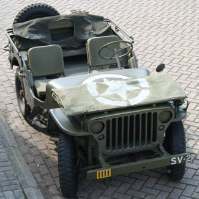
Wow, look at the wear on the rear tires on this Ford GPW Jeep -

By CollectorofThings · Posted
Hey guys! My nice navy set needed a chinstrap for the hood rubber line. I picked up this green buckle with nice patina. Has a green buckle on the reverse. I know there were examples of this during the war. Some goofball on Facebook has me re-thinking what I believe to be good to go. Just wanted some actual expert input thanks! First pic showing reverse and the anchor I put a little clp to help aid removing some white corrosion FYI in case someone thought it looked different. -
By KingCornChip · Posted
Got pictures? I just missed a nice estate sale in WI to a 32nd infantry division estate sale that had a nice pith. Unfortunately, estate sales seem to target people who don't work thursdays at 10 AM :P -
-
By Shanny1298 · Posted
Thanks! The iPhone takes some incredible macro photos. I don’t even need to bring out my Canon! Appreciate the response, Tonomachi 👍😊 -
By Matt_X · Posted
The question here is whether any of this story can be verified. The oldest version of that Wolfgang Fleck story I've found with simple web searches is from June 6, 2026. https://www.humanbehavior.co.uk/2026/06/did-any-american-or-british-soldiers.html A different story of a US vet with that name was posted on Instagram Nov 11, 2020 with a video. Someone else added a comment June 10, 2026 claiming 'Gramps' destroyed two Sherman tanks. https://www.instagram.com/p/CHdgnjtLhRs/?img_index=1
-
-

-

-

-
-
-
.jpg.2ce6a8d90c750304bcf9d4faa9318f5d.jpg.5a23d93005bf9ba70918d137e8d2e4fc.jpg)
-
-
-
-

-

-
-
* While this forum is partially supported by our advertisers, we make no claim nor endorsement of authenticity of the products which these advertisers sell. If you have an issue with any advertiser, please take it up with them and not with the owner or staff of this forum.