
-
Current Donation Goals
-
To send a donation, just click on
FORUM DONATIONS in the box above. -
Recent Posts
-

By Choctaw Dan · Posted
Hello, Opinel. I just happened upon this thread. Opseccc did a great job detailing this most excellent knife series. I heartily concur with his statement about rust, though I think the issue had something to do with some chemical reaction between the Gerber blade and some substance absorbed by the Gerber sheath during manufacture. Although I have seen and handled hundreds of Gerber LMFs and BMFs, the ONLY time I've seen it is when the knife had been stored in the original Gerber sheath. That, plus the fact that the pattern of the rusted area usually mimics the texture of the sheath's fabric. I can only offer a couple of additional bits. First, based on several email conversations with Gerber, the company did not keep serial number records on any but the Mark 2 series. A significant mistake, I think. Second, the LMFs with the brown handle and sheath were made for Cabelas. -

By dpast32 · Posted
Firstly, Yes, I am aware that this particular Post is not new, so to speak, however I myself just happened upon it yesterday while researching one on my Medal Groups concerning a Member of the very same Unit. I was amazed that someone was fortunate enough to have obtained this exemplary 'Foot Locker Group' apparently pretty much intact after all these years !! I have performed extensive Research upon a Member of the 486th's Battery B, 2nd Platoon who were amongst those assigned to accompany the U.S. 3rd Armored Division's Task Force Hogan, who were eventually Surrounded & Cut Off by the rapidly advancing German Forces during their Ardennes Offensive. In the interest of brevity here, I'll provide a simple overview of 'my' G.I.'s part within all of this. He was with the small Section of the Task Force included for AAA Protection, consisting of Battery B's 2nd Platoon, with 2 M-3 Halftracks, along with an 1/4 Ton Vehicle, a Jeep. The Halftrack's consisted of; 1x - M-15 w/ 1 37mm Cannon & .50 Caliber HMG, & an M-16 w/ 4x - .50 Caliber HMG Mount. [ Quad .50's ] My G.I. was assigned to the M-15. Their little Group was Commanded by 1st Lieut. Robert A. Wheatherford. The whole Task Force consisted that of 400 Personnel, a compilation of assorted 3rd Armored Division Components, all led by a Proud Texan, Lieut. Colonel Sam Hogan from Pharr, Texas. They left on 20 December 1944 & proceeded as Ordered. And, just a couple of days after departing U.S. Lines they began to encounter Enemy Roadblocks, pretty much at every Road Junction they approached. They happened upon an Evacuated American Supply Dump at LaRoche, & proceeded to spend the night there in addition to stocking up with anything they thought they might need during the upcoming journey. Moving out that next morning & quickly realized that irrespective of which way they chose to proceed, they were in essence surrounded. They then decided to hunker down, & circle the wagons, awaiting the Enemy to make the next move, all while contacting their Higher for further Orders ? The little Village they settled upon to defend was the Belgian Village of Marcouray, consisting of Stone Houses, & thus easy to fortify & thus defend. Naturally here I have skipped over & or around several related happening's to keep everything brief here to focus on my Guy & subsequent Decoration. So, after managing to repel numerous Enemy attacks on their positions, that along with hearing from their HQ that no Relief or assistance would be forthcoming, HQ decided that they should attempt a Breakout. So, immediately at dusk on Christmas Afternoon, December 24, 1944 the Task Force began their Night Time Exfiltration, all 400 Men then departed on foot, all within Groups of 23, each Commanded by 1 Officer. ( Their trek was to take them to Soy, Belgium which was then within Allied Lines. ) 'My' Group included the 16 Men of the 486th AAA-AW Detachment were led by the aforementioned Officer, Lt. R. A. Weatherford. Relatively shortly after the Group departed Marcouray, they were targeted by German Artillery in which they fortunately suffered only 1 Non-Fatal WIA Casualty, Sgt. John F. Coury from Pennsylvania. Yet fortunately for Sgt. Coury, he was being accompanied by his ever faithful Friend, PFC August, also of the Battery B's 2nd Platoon. Due to the nature of the Exfiltration, it was quickly decided that as Sgt. Coury was unable to walk under his own power, he would be returned to Marcouray where the T/F's Aid Post & Medical Section had remained, awaiting the German's with the hope that their Non-Combatatant Status & WIA Personnel would allow them through Enemy Lines without incident. It was at this point that PFC August stepped up & decided that he would not leave his Sgt. behind & proceeded to carry him on his back all night long throughout their Escape through Enemy Lines, where at times being in.such clot proximity to Enemy Positions they could overhear them speaking to each other. Thus PFC August was duly Decorated for his feat, but not with an American Decoration, but rather the British 'Military Medal', due to at that particular point in tme, the Unit was Officially under British Command, & Authorized by Bernard R. Montgomery himself. If you allow me a few minutes to locate some related Documents, I will try to get them Posted up here. To my knowledge, only 311 U.K. Military Medals { M.M. } were Awarded to U.S. Personnel during WW2, & yes, this Example is Officially Rim Named to the Recipient, in the U.K. Format. Best, Dom P. -
By Militaria_hogger · Posted
Hey everyone! I recently bought this amazing medal grouping belonging to Albert N Shepard Jr. included in the grouping was his Purple Heart with 3 OLC, his bronze star with 2 OLC and a V for valor, his legion of merit, his soldiers medal, and his ARCOM medal. Sadly his silver star was missing from the group and I’m not sure what’s happened to it. But I had some questions for y'all that maybe you can help me with! Looking at his picture it seems as if he has some ww2 awards. For example the victory medal, Philippines liberation medal, asiatic pacific medal, and the American campaign medal. But he was born in 1929, so he would have been 16 when the war was over. Is it possible he lied about his age to get in? I can’t find any info to sustain that, plus the article I have attached says he joined the military in 1946. But he also wears a CIB with 2 stars, which is for combat in WW2/Korea/Vietnam. Any help/documents that you can find would be much appreciated! I am making a request to the NPRC to see if I can get copies on his award documents/other documents. Thanks everyone! -
By Vendeen85 · Posted
Hello, I have this HBT M43 jacket, with its gas flap and riveted 13-star buttons. However, we can clearly see traces of patches that were once sewn above the chest pockets. When did the U.S. Army begin using the "U.S. Army" tape and name tapes on uniforms? Is it possible that this jacket was reused during the Vietnam War? Thank you very much for your help! Best regards -

-

By Father V · Posted
A lot of the design is a throwback to the earlier era Ames. I like it! -

By SARGE · Posted
Great find for an early Revenue Cutter Service weapon. -
By USRICK · Posted
I have a Camillus Mark 1 that I purchased about 4 years ago. The difference being it is in a NORD- 8114 Mark 1 scabbard. Someone sharpened the factory edge and scuffed the parkerizing a bit, other than that it looks like it was made yesterday. And you could probably shave with it. Since that time I have a acquired several more Camillus ww2 Era knives, particularly the Mark 2 Camillus variations. I am afraid Mr. Skip is right about this becoming habit forming as I am becoming more O.C.D. about Camillus, so to remedy this problem I recently purchased a Pal RH-35 Mark 1, Just got it today! Hope all of you are doing well. -
By brad k · Posted
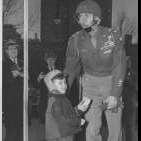
the fireing pin should be looked at if you intend to shoot it, the orig. one from this period is round and they were changed to a flat sided one. the round ones were breaking behind the tip and would hit the primer before the bolt was fully closed. also look at the face of the chamber, if it is shiny or in the white as collectors call it then the rifle hasn't been refinished, if it's parkerized like the rest of the finish then it's been refinished. not many m1's from this period that didn't get overhauled during or after the war except the lend lease rifles, so that would make it very collectible, the GHS stock would sell for hundreds by itself. I don't see any chrome, that would be around the gas port hole. the early flush nut sight's were commonly replaced to lock bar during the war as the flush nt ones didn't work out so well, I think you've got a realy nice rifle from what I can see and I probably would leave it as is verses correcting any later parts, as long as the parts are all ww2 period then it makes it a correct period rifle that got normal use. -

By rathbonemuseum.com · Posted
The second enlisted cap is what we see described in the 1938 regulations with a full band of branch of service indication on the body of the cap.
-
-

-

-

-

-
-
.jpg.2ce6a8d90c750304bcf9d4faa9318f5d.jpg.5a23d93005bf9ba70918d137e8d2e4fc.jpg)
-

-
-

-

-

-

-
* While this forum is partially supported by our advertisers, we make no claim nor endorsement of authenticity of the products which these advertisers sell. If you have an issue with any advertiser, please take it up with them and not with the owner or staff of this forum.