
-
Thank You for Supporting USMF
-
Forum Donations
-
-
To send a donation, just click on
FORUM DONATIONS in the box above. -
Recent Posts
-

By ibrown1776 · Posted
Hello everyone, I wanted to share my campaign hat collection with you all. I have attempted to organize the photos and descriptions by date to the best of my ability. Let me know your feedback, if you have any corrections, or if you would like more pictures. I know the photos I provided will not show everything as I have described. The first one is likely issued, no sweatband remains, and there is a partial tag on the inside that says Marshalls New York. Other than that, it adds up to either a 1913 or 1916 version. There is a shoelace chinstrap that routes under where the sweatband would be, through eyelets under the ribbon. The grommets on the crown to the brim are about 5 3/4 in. There are 5 rows of stitching around the brim. I can't tell if it's 1913 or 1916, though, because the brim stitching is hard to tell if it's silk or cotton. There are eyelets cut into the brim near the base. This was a common modification by soldiers. The second one is definitely issued, either 1913 or 1916. Has a very faint inspection stamp and a very nice sweatband with no other markings. All other features are the same as in the first, except for the cut eyelets. The hat cord is a very faded blue for infantry. The third one is a private purchase. Has the maker Stetson and the retailer on the sweatband. Not sure when it was made, I want to say 1918 because of the oblong eyelets on the brim, but there is a tying cord as opposed to a leather chinstrap, which was likely preferred and had already been adopted by 1918. There are two rows of stitching around the brim. The fourth hat is from WWII. I know nothing about WWII campaign hats other than that their construction is much stiffer than that of WWI hats. There is no brim stitching, small remnants of a leather chinstrap, and an absurdly long infantry hat cord. The crown is reduced to 5 1/4 in. Campaign hats continued to be worn in the Pacific theater and Alaska, as well as by the mainland cavalry. The fifth hat is beyond the scope of my interest in these hats. It is clearly from the Vietnam era at the earliest. Below are the campaign hat regulations I used to date the WWI hats. They were posted here by "world war 1 nerd" years ago. Thanks for looking! Spec. 1145: Adopted January 2, 1912 1. The crown is 5 1/2 inches high. 2. The four ventilation eyelets are each 2 3/4 inches from the base of the crown. 3. The brim is 3 inches wide, and has no stitching. 4. There are two slits/holes on the brim, one on each side of the crown, 1/4 inch inch from its base and 1 1/4 inches forward of the crown's center point. each hole was reinforced by a round felt eyelet on the top side of the brim, through which the regulation flat braided tying cord passed. Spec. 1177: Adopted April 10, 1913 1. The crown was extended 1/4 inch to 5 3/4 inches high, to allow for better air circulation inside of the hat. 2. The four ventilation eyelets were each raised by 1/4 inch making them 3 inches from the base of the crown. 3. The edge of the 3 inch wide brim was reinforced with five rows of silk stitching. 4. The location of the eyelets for the flat braided tying cord remained 1 1/4 inches forward of the crown's center point; however, they were moved to the base of the crown and under the sweatband. The circular felt reinforcement pieces were omitted and replaced by a pair of round eyelets (one on each side). Spec. 1248: Adopted September 6, 1916 1. The crown remained at 5 3/4 inches high. 2. The four ventilation eyelets remained at 3 inches from the base of the crown. 3. The five rows of silk thread at the edge of the 3 inch wide brim was replaced with five rows of mercerized cotton. 4. The round eyelets for the flat braided tying cord remained 1 1/4 inches forward of the crown's center, and at the base of the crown and under the sweatband. Spec. 1289: Adopted December 21, 1917 1. The crown remained at 5 3/4 inches high. 2. The four ventilation eyelets remained at 3 inches from the base of the crown. 3. The five rows of mercerized cotton thread remained at the edge of the 3 inch wide brim. 4. The eyelets for the flat braided tying cord remained 1 1/4 inches forward of the crown's center point; however they were moved back to the brim and 1/4 inch from the base of the crown. The round eyelets were replaced with oblong eylets to accomodate the recently adopted 1/4 inch wide leather chinstrap. Before this time leather chinstraps were non-regulation and a strictly private purchase item. Spec. 1357: Adopted August 22, 1918 1. As a wartime economy, the crown was reduced 1/4 inch to 5 1/2 inches high. 2. The four ventilation eyelets remained at 3 inches from the base of the crown. 3. The width of the brim was also shortened 1/8 inch to 2 7/8 inches, and the five rows of mercerized cotton thread at the edge of the brim was reduced to just two rows. 4. The two oblong eyelets for the leather chinstrap remained 1 1/4 inches forward of the crown's center point, and on the brim, 1/4 inch from the base of the crown. -

By Bluehawk · Posted
Well said... and so, as always, we're not going to know the unknowable. SECDEF Rumsfeld (IMHO) said it best: "Reports that say something hasn’t happened are always interesting to me because, as we know, there are known knowns: there are things we know we know. We also know there are known unknowns: that is to say, we know there are some things [we know] we do not know. But there are also unknown unknowns—the ones we don’t know we don’t know. And if one looks throughout the history of our country and other free countries, it is the latter category that tends to be the difficult one." -
-

-
By teufelhund · Posted
Pic taken at the tempory exibition Criqueville en Bessin ( Pointe du Hoc) for the 75th DDay anniversary. -
By Salvage Sailor · Posted
Lost my detailed notes and photos of Jack Evans service career in a PC crash several years ago, but these are my scratch notes on his service. He commanded a AAA unit attached to the 2nd Armored Division from Normandy to Germany, and a AAA and FA Battalion in Korea. He was the commander of the 82nd Divisional artillery in 1965. NOTES - not detailed, nor in order so if someone wishes to fill in the blanks I'd be obliged. Father, Jack Cecil Evans, Colonel, CAC JACK CECIL EVANS, O-23517 Graduated UC Berkeley 1939 2nd Lt Reserves CAC, Economics. 2nd LT 65th CAC 1939 Second Lieutenant Jack C. Evans to Panama Canal Department, sailing San Francisco, November 30, Coast Artillery Journal, November-December, 1940, Volume LXXXIII Number 6 2nd LT Evans, Jack C., Jr. (O23517) Born California 14 Aug. 1918, A-Calif. A.B., Univ. of Calif., 39. Source Army Register 1941 & 1942. Active List promotions, 1944, 1st LT 3204 Evans, Jack C., Jr CAC (as of 1 Jul 43) Regular Army CAC Officers - Evans, Jack C, Maj., TAS, Ft. Sill, Okla., July 1948 Btry A, 6th FA Bn Sep 1949 Jack C. Evans, Jr., Capt. FA Fort Sill. Oklahoma 15th AAA AW BN (SP) Lt. Col. Jack C. Evans, Jr., Comdg. (KOREA) By Capt. Michael G. Collins Recently the 15th AAA AW Bn (SP), organic to the 7th Infantry Division in Korea, has undergone an intensive training program in preparation for ATT44-3. To prepare for the AAA Firing Phase of the test with so many new men, Lt. Co!. Evans devised a plan to use a second lVII8 sight, mounted adjacent to the primary sight on the M16 sight bar, as a means of checking each gunner's ability to use "image spin" in tracking aerial targets. To mount this sight an additional bracket is placed on the sight bar !-2" to the left of the primary sight bracket with the machined clamp up. The auxiliary sight is then rotated upward and to the rear before being inserted into the bracket. Normal procedures are then employed to orient the primary sight and to boresight the guns. Following orientation, the hub of the primary sight is placed upon the orienting point and the auxiliary sight is then oriented on the same point by use of the orienting cam screws and locking bolts until the auxiliary sight is oriented with both the primary sight and the guns. The gunner is then instructed to track the aerial target employing "image spin" to gain proper line, correct lead. The instructor is enabled to check each gunner and verify that he is employing the proper techniques by means of the auxiliary sight. This system provided a rapid and effective means of training the gunners, and the improvement was reflected in the AAA Firing conducted at Inchon in September. Source: Antiaircraft Journal, November-December, 1954, Volume LXXXXVII Number 6 Air University Periodical Index - Atom rockets for bases. ANR 78:9 Mr 2 '57 Atomic air defense. Lt Col Jack C. Evans, Jr. diag Military R 38:21-31 Apr '58 January 1965, 82nd Divisional Artillery, Col. Jack C. Evans Commanding. Source: The National Guardsman, January, 1965. Army Register 1965 – EVANS, Jack Cecil Jr 023517 B-Calif 14 Aug 18 A-Calif BSM(OLC) Grad US AWC 63 C&GS Coll 52 Arty Sch O Adv Crse (ShC) 48 O Adv Crse 50 AB in Econ Univ of Calif 39 MA Geo Wash Univ 63 2lt CA Res 19 Sep 39 to Col AUS 7 Jul 61 RA 2lt CAC 1 July 40 D/R 1 July 40 to Lt Col 1 July 60 PL 2525 Army Register 1966 – EVANS, Jack Cecil Jr 023517 B-Calif 14 Aug 18 A-Calif LM BSM (OLC) Grad US AWC 63 C&GS Coll 52 Arty Sch O Adv Crse (ShC) 48 O Adv Crse 50 AB in Econ Univ of Calif 39 MA Geo Wash Univ 63 2lt CA Res 19 Sep 39 to Col AUS 7 Jul 61 RA 2lt CAC 1 July 40 D/R 1 July 40 to Col 1 July 65 PL 1637 Office of the Chief, Research and Development, Data Automation Panel, Department of the Army February 1967, Col. Jack C. Evans, Jr., Assistant Chief of Staff for Intelligence. Jack Evans, 95 years young – Kauai magazine April 2014 Jack was born and raised in California cattle country. He joined the military, served in the United States Army and made his career as an officer for 28 years, retiring at a full Colonel. He moved to Kauai to live with his son and daughter in law in Princeville. In 2006 he moved to Regency at Pukea. He has lived an extraordinary life and enjoys each day as it comes. -
By MWDVET · Posted
Here is the version I have in my collection. It seems to fit the diagram that another member posted a while ago. Their collection contained both variants and they had what looked to be a full set. -
-
By Equi · Posted
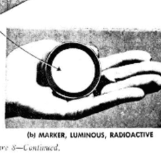
This is one of the first radium markers I got in my collection. During WW2, the Navy employed Type 1 and Type 3 luminous markers on boats serving as deck and personnel markers. This is the Type 1 variant, which is essentially just the clip-on type of marker missing the clip. These Type 1 disks were fitted with a metal ring on the back with two screws. These rings would be welded to bulkheads to hold the marker on. By 1951, the Navy had switched to Strontium-90 based luminous markers to replace the dangerous dose rates from radium. From the information I have gathered, the last year radium markers were produced was 1954 before fully switching to Sr-90. This specific disk is missing the screws and bulkhead ring on the back. It was likely removed off the ship and kept by a soldier. The phosphor inside the plastic housing has sadly broken up in spots. This marker is very weak radiation wise compared to others I have seen. Currently, this is the only Type 1 deck marker I have in my collection. -
By Titanfan · Posted
Hoodwinks is probably his unit's newspaper. Most units had similar publications they circulated on a semi regular basis, especially in occupation.
-
-

-

-

-

-

-
-
.jpg.2ce6a8d90c750304bcf9d4faa9318f5d.jpg.5a23d93005bf9ba70918d137e8d2e4fc.jpg)
-

-

-

-

-

-

-

-

-

-

-

-
* While this forum is partially supported by our advertisers, we make no claim nor endorsement of authenticity of the products which these advertisers sell. If you have an issue with any advertiser, please take it up with them and not with the owner or staff of this forum.