
-
Current Donation Goals
-
Forum DonationsRaised $2,461 of $7,500 target
-
-
To send a donation, just click on
FORUM DONATIONS in the box above. -
Recent Posts
-
By thorin6 · Posted
Based upon the earlier thread that Charlie Flick posted, it appears this 7-inch bladed knife is early 1920s. It has the aluminum pommel and the 1/2-inch pommel nut. -
By B-17Guy · Posted
Most of mine are the same. John -
By MaximumHistory · Posted
Minor correction in my post, I had accidentally written "26th Marine Regiment" for some reason occasionally instead of "29th Marine Regiment", please excuse this error as I must not have noticed when I was typing. The 26th Marines never operated on Okinawa during the war. -
By ludwigh1980 · Posted
Yes, both groups as well as the grandson's of the General who graduated from the AIr Force Academy in 1995. Much of his Cadet uniforms were there as well. Hard to say if the hat was there. The General passed in 1994, so it may have disappeared from the group years before. I like theater tailored uniform and the Hong Kong tailoring made it that much better. There were pictures online of the military stuff at the estate sale however they were not the focus. This is the 2nd USAF General I have pulled out of the woodwork in the last year, that one being a Brigadier. It is amazing to note the changes that occur in the career course of a long serving officer or NCO especially those that served before WW2. One thing I might utter as a word of caution: I have been collecting uniforms for several years and would be hesitant on restoring insignia. Most of my collection has come out of the woodwork. Often, I pull the uniforms myself out of the closet, trunk, etc. Families tend to strip the insignia, that's what makes one such as the group above so remarkable to me. A stripped uniform out of a dusty closet with a name and history is much more exciting to me than a restored uniform at a show or on ebay. There is almost no way to tell if the Vet wore it like that or how much has been done. Notes and files on uniform gets lost. Often, I have found, Vets did not wear everything to specification of what they were entitled to. I know it's pretty common however I have begun to appreciate artifacts as I found them and the story they tell. -
By aznation · Posted
Fact 1: Robert G Rogers was a doctor in WWII. As far as a Texas connection he was at one time at Camp Swift, TX which is 28 miles east of Austin, TX and 7 miles north of Bastrop, TX. The wonderful world of the internet may not be as reliable as one would think. The Robert G Rogers whose call sign was W5IMP is the person whose WWII Draft Registration is below. As far as I can tell he didn't live in San Antonio before or after the war but in Austin and I think he may've died in California in 2007. Note the street address of residence is 1902 David St, Austin, Texas which matches his address on the call sign W5IMP. I did some looking and couldn't find any evidence that the person below was a doctor. That doesn't necessarily mean he wasn't but I just don't believe he was. Fact 2: Below is the actual NARA WWII Morning Reports of the officer whose trunk you have shown photos of. These reports are of Robert G Rogers, Officer Service Number: 0547423 and NARA's Morning Reports currently are online up through December 1944. They're working on getting 1945's reports online right now but the time of completion is unknown. The highest rank on the latest Morning Report for Robert is 1st Lt. He might've made higher rank after 1944 but I just don't know. WWII NARA Morning Reports - Robert G Rogers.pdf When doing a search for Dr Robert G Rogers on Newspapers.com there are so many that if one doesn't have some additional information to narrow the results then it might not be possible to get the right one. I noticed there what I determined later to be a packboard in the contents of the trunk. Here's some more information on that. Note: The information below came as results from a query on Google so you might want to verify the information. Personally, I think most of the information is correct. During World War II, the American Seating Company manufactured the standard U.S. Army Plywood Packboard, which was designed to carry heavy, oversized, or awkwardly shaped equipment over terrain where wheeled vehicles and pack animals could not go. The curved, U-shaped packboards weighed roughly 4 pounds and used a laced canvas backing to protect the soldier's back, serving as an adaptable gear-hauling platform. They were unit-issued gear, rather than assigned to individuals. Specific combat and logistical uses included: Communications: Transporting bulky, heavy field radios (like the SCR-284) and rapidly laying spools of telephone wire for frontline command posts. Combat Engineering: Hauling boxes of explosives, demolition charges, and heavy pioneer tools for bridging or fortification. Medical Support: Carrying litters and the necessary crates of supplies for medics to establish forward aid stations closer to the battlefield. Ammunition & Supplies: Transporting heavy crates of mortar shells, artillery ammunition, and daily rations across steep or muddy environments (heavily utilized in the Pacific Theater and the mountains of the Aleutian Islands). The design was highly successful and remained a staple for the U.S. military for over 30 years. I would like to know the who, what, where, when and why of how the trunk was obtained and if there's any further information that might help narrow this person down. Who?: You say a fellow antique collector obtained this at an auction. Where?: Where was the auction, like what state, city, etc. Was it an in-person auction or an on-line auction? If an online auction, does the person know where the on-line auction originates from? When?: How long ago was the trunk obtained? How?: Already incorporated into some of the above question/s. By the way, I note that you are located in North Dakota. IF that is where the trunk came from there is/was a Dr Robert G Rogers that was pretty well known and was a doctor during WWII and it might well be his. Let me know. Thanks...Matt I notice there is some cold weather gear like some heavy duty cold weather mits. Something to note is the real Dr Robert G Rogers was at one time assigned to the Mayo Foundation (known now as the Mayo Clinic) in Rochester, Minnesota. He was also at Ft Devens and Framington, both in Massachusetts, Atlantic City, NJ, and the Medical Field Service School at Carlisle, PA. All of those places, especially Minnesota can get pretty dang cold, so that's maybe why he had those winter mits. Detailed breakdowns by month according to the Weather Spark Rochester Climate data: December: Highs average around 31°F with lows around 16°F. January: The coldest month sees average highs around 24°F and lows around 9°F. February: Highs average around 32°F with lows around 16°F. -
By guerrap · Posted
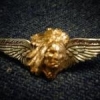
For what it is worth, I thought it may be informative / helpful to provide a side-by-side comparison of the Shreeve and the Shreeve-style wing. On top is the Shreeve-style wing and measures at 3 1/4”; the Shreeve measures at 3 7/16”. -
By guerrap · Posted
Recently acquired one of the unique Shreeve-style wings. In conferring with @cwnorma, there are not many examples known and the information @cwnorma provided in 2020 is still all that is known on this pattern. -
By MaximumHistory · Posted
For any and all who are interesting in anything else I have scanned, I will leave a link to my archival website below. I run my archival site as a non-profit, educational source for individuals to see and understand photographs from the Second World War and Postwar that have not been seen digitally before. I currently support over 350 individual photographs on the archive, and I add more every few weeks. While not all the pictures present here are U.S.-focused, many of them are and may be of interest to many people present on this forum. If you are browsing and find any inaccuracies with my information and captioning, please inform me via PMs. I do whatever is in my power to have the most accurate descriptions to help keep people educated on what they see. https://karlhistoricalarchive.weebly.com/ If posting this here is against the rules of this forum, please inform me, but in my searching of the rules section I did not see any direct mentions of posting personal non-profit sites such as mine. Many thanks to all. -

By m1903 · Posted
Never been to this show, is it just insignia or do you get medal dealers also ? -

By Big Iron · Posted
I'm guessing the hat was gone? That is quite a score, really. I have been interested in collecting career military uniforms that started in WWII or previous because of their lower cost and somewhat more interesting history. I'd love to find a double or triple war uniform (WWI-Korea or WWII through Vietnam). I have one from a local vet, but I need to request his service records so I can figure out how to configure it. Did you get both uniform sets (colonel and general)?
-
-

-

-
-
-
-
.jpg.2ce6a8d90c750304bcf9d4faa9318f5d.jpg.5a23d93005bf9ba70918d137e8d2e4fc.jpg)
-

-

-

-

-

-

-
* While this forum is partially supported by our advertisers, we make no claim nor endorsement of authenticity of the products which these advertisers sell. If you have an issue with any advertiser, please take it up with them and not with the owner or staff of this forum.