
-
Current Donation Goals
-
To send a donation, just click on
FORUM DONATIONS in the box above. -
Recent Posts
-
By MMcollector · Posted
better photos. Looks struck to me, what do you think Josh? Thanks. -
By walika · Posted
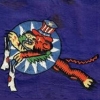
Cool images, thanks. I have not seen a 10th Combat Camera Unit patch before. How did you arrive at its identification? Rick -

By ftiger · Posted
Hi WALIKA and anyone else, I know these posts were from 2018 or so, but they remain a valuable resource! By any chance did you or anyone else did a follow-up including info, photos and most importantly the unit emblem for the 10th COMBAT CAMERA UNIT (from the CBI)? I’m desperately looking for clear shots of a patch, emblem for this Unit. I believe it should look like the ones in these pics, but unfortunately their resolution is not great at all… Any and all help is highly appreciated! -
-
By jumpship · Posted
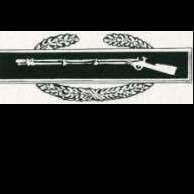
Based on his discharge form (WD AGO 53-55) and the documents above, it appears that he did not complete the bombadier course at Carlsbad AAF, NM and remained as a Cpl with an enlisted MOS of 611 (Aerial Gunner). Based on his decorations, it does not look like he ever left the USA. The uniform in his portrait is that of an Army Air Forces officer (with the gold wings on his lapels indicating the AAF branch). I’ll defer to the experts on here as to whether that would have ever been worn by AAF enlisted students or if it, like the 2nd Lt bars and silver wings found in his pockets, was an indicator of his hopes for a future commissioning. Dan -
By Transylvania · Posted
Want to say a big thank you to everyone who has helped shed light on these two items (OriginalCollector, manayunkman, easterneagle87, and Edelweisse) and for creating another fond memory associated with my Grandfather. The knowledge shared on this forum has been really impressive and my parents have enjoyed me relaying everything back to them. It has been much appreciated. -
By mikie · Posted
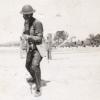
Ha! 🤣 Are these well known comedians over there? They don’t look familiar to me. Man, I can sympathize. The old finger stab to get a test sample used to hurt way more than the actual needle in the arm. But thanks to modern science, they haven’t done that in a year now. They put a thingee on your thumb. It squeezes and relaxes a few times and there you go, test results pop up on the monitor. The whole thing is pretty painless now. mikie -
-
By General Apathy · Posted
. Hi mikie, well done, ' they also serve that donate blood '. Hopefully here's a one minute video of an English comedian in 1961 with a little scene about donating blood. Norman D. Landing, Forum Normandy Correspondent, 05 June 2O26. .. -

By Combat Camera · Posted
While not my typical focus, one of the coolest woodwork groups I’ve found lately that I wanted to share for tomorrow’s anniversary of D-Day: a squad leader wounded in the first wave on Omaha Beach with G Company, 116th Infantry Regiment, 29th Infantry Division. In 1919, Raymond E. Johnson was born in the small town of Crewe, VA. Many of his early days were spent on the farm, watching his father work the land while his mother took care of the children. Although he was already the third child, the family continued to grow and Raymond became an older brother to three more siblings. To accommodate, the family moved to various neighboring towns throughout Raymond’s childhood while his father found work as a painter. After attending two years of high school, Raymond joined his father in the painting business until he felt called to the service, enlisting in the National Guard in early 1941. Raymond traveled about 30 minutes up the road to join Farmville’s Company G of the 116th IR, and began training in the following months. In February the regiment was officially called into federal service, and draftees began trickling in over the course of the year. In October and November of 1941, Johnson and the rest of G Company joined the 29th Division to participate in the Carolina Maneuvers. Part of the 1st Army, the 29th ID was assigned to the “Blue Force” and found itself next to the 26th, 28th and 44th IDs as part of the II and VI Corps. During the war games, the Army was able to test various logistics, tactics, and coordination with over 350,000 troops as the war overseas continued to heat up. Johnson heard the news of Pearl Harbor while traveling with the division back to Fort Meade. Shocked but finding all the more reason to do his duty, he stayed with them while they began amphibious training in early 1942, and into their official deployment to England in October. The 116th continued vigorous training throughout 1943 and Raymond soon began to realize that they had a daunting task ahead of them: invading Germany’s “Fortress Europe.” Rising to the rank of Staff Sergeant and becoming a squad leader by 1944, he knew he would have a crucial role in the invasion and the lives of his men. Johnson and the company continued to train in amphibious assaults at Slapton Sands and Woolacombe Beach, all the while growing more nervous about the impending invasion. As D-Day approached, Raymond was briefed that G Company would be in the first wave of infantry to land. Their objective was to drive inland from the Dog White sector of Omaha Beach, between A and F Company. On June 5th, they boarded the USS Thomas Jefferson and headed towards Normandy. Many of the men recalled being relatively silent, with sleep being hard to come by as they all prepared themselves for what they were about to face. Eventually, a little after 0300 the next day, Johnson and his squad climbed down into their LCVP. Leaving over an hour later, it’s hard to imagine what Raymond might have felt. Between the thousands of ships, naval and aerial bombardments, and incredible fear of the rapidly approaching coast, all he could do was remember what he trained for. When G Company reached the beach right around 0630, they were completely disoriented. Tanks from the 743rd Tank Battalion which were supposed to precede the landing sank in the channel, and the entire company drifted off target almost 1,000 yards to the east–now in the Dog Red and Easy Green sectors. Raymond and his squad were in one of two boats that drifted even further, and ended up landing towards the far end of Easy Green. When the ramp dropped, Johnson set foot on Omaha Beach at H-Hour+1 minute, and was greeted by heavy German machine gun fire and artillery shells from seemingly every direction. While other boats of his company mistakenly landed at a spot covered by a large wall of smoke from burning grass, Johnson’s was just outside of it, and suffered heavy casualties as a result. The scene was chaotic in every sense of the word. Raymond C. Mays, another sergeant in G Company, described the landing: "The next thing you know, there was all this shelling going on and bullets flying and people falling down as far as you could see…I made it to the shoreline, two other boys landed right beside me. One of them Bouncing Betties went off, blew a hole in the ground and wounded the other two boys…Everybody in my platoon got hit somehow or another, I had holes in my pack. One boy was shot through the helmet but survived. We had lost everything except I think one tank and an artillery piece." Another account from Francis L. Simeone, a private in the company, described that “one of the first killed was Sgt. Neff, hit by a 20mm shell, instantly killed, lay..in the water partway up to the beach.” Simeone, like many others that day, quickly found that his rifle malfunctioned from the dirt and sand that worked its way through the plastic bags used to cover it. He recalled seeing his friend Ryan badly wounded by mortar fire, so he engaged in some light conversation with him, then traded rifles so he could fire back. It was a truly chaotic and horrifying sight, with each man able to do nothing more than trust his instincts. Although much of G Company made it to the shingle with relatively lower casualties compared to the other sectors, their flank was still exposed and their objective of Dog White remained wide open. Realizing the vulnerability, some squads of the company tried to close the gap, only to be met with heavy fire and mines that decimated the troops. After about 30 minutes of intense fighting they were finally joined by the second wave, which didn’t fare much better than the first. Artillery and machine gun fire still ripped through the water and sand, decimating men as soon as they left their boat. Even with the reinforcements, it took another hour or two of hellish fighting before Johnson and the rest of G Company could finally move off the beach. Rather than advance through the heavily fortified draws, troops began climbing up two separate bluffs on either side of Les Moulins. Johnson’s squad joined the 3rd Battalion of the 116th IR, who pushed south toward St. Laurent. He led what was left of his squad further west into the broken defenses that caused so much carnage to his comrades just hours earlier. As they moved inland, there was fairly little resistance until they reached the edge of the town at around 1200. The joint force of 2nd and 3rd Battalion units was continuously reorganized for attacks throughout the afternoon but saw little success in the tight hedgerows. They were eventually reinforced by the 115th IR, and began to work their way to join the rest of G Company and 2nd Battalion at Vierville. Able to take a break for the first time since debarking, Raymond attended to a wound he suffered in his elbow, but previously ignored to focus on the critical task at hand. Given the circumstances he was incredibly lucky that the injury was all he walked away with. Before they hit the beach, G Company still had about 15-20 of the original National Guardsmen from Farmville, but was left with only 3 still in action by the end of the day–including Raymond. Of his squad, he lost 4 of the 9 men in the landing, with another wounded 3 days later. Over the next few days, all three battalions of the 116th IR rejoined each other and began moving west to mop up the remaining scattered Germans in the area. On D+5, Johnson was pleased to hear that the regiment was put in reserve to reorganize after the landings. Just two days later, however, they were told to move out towards St. Clair-sue-l’Elle, northeast of the vital town of St. Lo. G Company fought with 2nd Battalion and was able to take the town before midnight. After demonstrating his leadership and dedication to his men from Omaha Beach to St. Clair, Johnson was promoted to Technical Sergeant on June 20th. For the next few weeks, G Company and the 29th ID turned to defensive positions to the east of St. Lo. Although there weren’t many overwhelming counterattacks from the Germans, danger still remained. Patrols were repeatedly sent out to find enemy positions, and there was constant artillery and mortar fire. Before Raymond could lead his men into St. Lo, the danger caught up to him. On July 10th he was badly hit in the back of the knee by artillery shrapnel, near a major artery. He was immediately evacuated due to the seriousness of the injury, and spent the next few months recovering. According to Raymond’s family, he recounted these as some of the hardest months for him–not just because of the physical pain, but because of the time apart from his men. While recovering, all he could think about was getting back on the line to be there for his squad. By the time Johnson returned as a platoon sergeant in late October, G Company was completely different than he knew it a year prior. Of the 9 men he commanded on Omaha Beach, only him and one other stood, the others KIA and another taken as a POW. While he was gone, the division suffered significant casualties at St Lo then moved to take Brest, and on towards the Siegfried Line. In early November the 116th IR returned to the line, in preparation for the assault towards Jülich: one of the biggest obstacles between the Americans and the Rhineland. A couple days before the push, General Eisenhower himself came to inspect Johnson’s platoon, and a photo of the general talking with some of his men was featured on the front cover of The Stars and Stripes. When the orders came, the 116th IR moved to attack Setterich, on the 29th ID’s left flank. They were able to take the town in just a few days, then moved on to Koslar, where G Company made a daring move. After bitter fighting for over a week for the town, 2nd Battalion was sent to help in the northeast and reached about 500 yards from the city. On November 24th, G Company dug in to fill in the gaps between 2nd and 3rd Battalion, but the muddy trenches remained static. Along with F Company, they noticed that between their trench and the outskirts of Koslar laid one other row of trenches–cutting the distance in half. They hatched an idea and decided that early the next morning they would charge to the next trench, regroup, then charge to the town. As the time came at 0700 on the 25th, Raymond told his men to fix bayonets, climb over the top, and charge. Within about 10 minutes both F and G Company made it into Koslar, completely disorganized in the complete darkness, but with no enemy to be found. When daylight came they formed defensive positions, but heavy German artillery rained down and cut off the companies from the rest of the regiment. Springing the trap, the Germans then began a counterattack and forced Johnson and his platoon to fight for roughly 60 hours straight without sleep or supplies. Finally, on the night of the 27th, men of 1st Battalion were able to enter the town and make contact with the two isolated companies. In early December, the 116th IR made it to the Roer River, but then stopped once the German winter offensive started in order to hold the line. After a comparatively uneventful Christmas from their comrades to the south, the next big assault came in late February 1945 when they finally crossed the Roer, then continued to move further into Germany. After the last-ditch effort in the Battle of the Bulge, the Germans were all but defeated as they desperately tried whatever they could to stop the advance into their homeland. It was a far cry from the fierce enemy that Raymond faced less than a year prior on the beach, but more than anything he considered himself incredibly lucky to see the war to its end. Johnson returned to the states in July, having spent nearly the past 5 years of his life with G Company. The things he saw and men he lost could never leave his mind, but he did his best to adjust to civilian life. He married his fiancee upon return and once again found work as a painter, occasionally also volunteering as a firefighter. He and his wife soon had a daughter and son and settled down near Hampton, VA in the following years. Just when Raymond was finding his footing, he was tragically diagnosed with a brain tumor and passed away in 1954 at only 33 years old. Despite passing away at such a young age, he left a big impression on his family and was beloved by many for decades to come–even inspiring his children to research his part in the “Great Crusade,” so many years ago.
-
-

-

-
-
-
-
.jpg.2ce6a8d90c750304bcf9d4faa9318f5d.jpg.5a23d93005bf9ba70918d137e8d2e4fc.jpg)
-

-

-

-

-

-

-
* While this forum is partially supported by our advertisers, we make no claim nor endorsement of authenticity of the products which these advertisers sell. If you have an issue with any advertiser, please take it up with them and not with the owner or staff of this forum.