
-
Current Donation Goals
-
To send a donation, just click on
FORUM DONATIONS in the box above. -
Recent Posts
-
-
By phantomfixer · Posted
That is cool… good way to store loose ammo… enblocs are cheaper than mags.. I did have a feeding issue… I tried polishing the feed ramp -
By WWII Parachutist · Posted
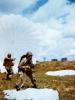
The harness on the left is a B-9, and the one on the right is an A-5. The pack, as marked is an A-4. The B-9 is a back model missing the pack, ripcord, housing and obviously the canopy. The A-5 is a two part system, and the harness itself looks complete. These are very late war items, and very rarely used. The B-9s were issued late in the war, and pulled from service very quickly. The A-4 was a late war item, and only seen in the last months of the war. The superseding A-5 was used even less. You might see a couple on B-29s in the last month or two of the war in the Pacific, but that's about it. I generally don't recommend the A-4 most displays, and I definitely don't recommend the A-5. These are somewhat rare late war items. For value though, keep in mind most people collect items widely used during the war. If it was AN-6513 or A-3, buyers would be jumping for them. Rarity and value, in this case, are inversely related. We do often answer emails with parachute questions on our website, although we can't always get every single one. Also, the term "Fake" is better applied to those selling with intent to deceive. Reproduction is a better term for replica gear. -
By SGT - E-4 · Posted
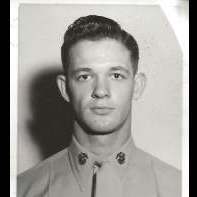
Would you be so kind to identify the medal shown in this report. Am I missing something that is already there? -
By HUD69 · Posted
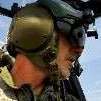
Some more information and a link to the source. US Army Concept Team in Vietnam (ACTIV), "Evaluation of Improved Fire Resistant Flight Coveralls," 1967 — DTIC report AD0814366. This is the primary document behind the fire-resistance narrative; it explicitly references the 17 February 1967 ACTIV letter on improved fire-resistant flight coveralls and the "Fire Resistant Flight Uniform (ENSURE DA 174)" tasking from March 1967. https://apps.dtic.mil/sti/tr/pdf/AD0814366.pdf A part of the text: The original "NOMEX" flight coveralls tested in Vietnam in 1966 was an altered version of the flame resistant flight coveralls developed by the US Navy. It was determined unsatisfactory for wear in Vietnam because of physical discomfort and irritation caused by the coarsely woven fabric. In addition, the coveralls were made of double layer fabric which was found to be excessively warm. The improved flight coverall is made of a closer, smoother woven NOMEX material designed to be less irritating. Several design changes were made in the coverall to correct deficiencies reported in the previous evaluation. To expedite the procurement of a desirable flame resistant flight coverall for wear in Southeast Asia, an accelerated evaluation was directed by United States Army, Vietnam, -
By Cobra 6 Actual · Posted
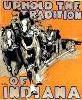
Thanks for posting that buckle, EE87. Whatever Donald E. White paid for that buckle, he surely got his money’s worth. -
By BEAST · Posted
I agree, plus on FB Vietnam collectors page, similar examples are being shown. -
By Jamecharles · Posted
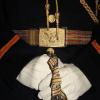
Further info: Laurence Bolton Keiser was born in Philadelphia, Pennsylvania, on June 1, 1895. He graduated from West Point in April 1917, 118th in a graduating class of 139, in the same class as J. Lawton Collins, Matthew Ridgway, and Mark W. Clark, two weeks after the American entry into World War I. Military career Dispatched to France with the American Expeditionary Force during World War I, Keiser was quickly promoted to temporary captain and appointed to command of 1st Battalion, 6th Infantry Regiment, a unit of the 5th Division. He was awarded the Silver Star for actions on the Western Front. Interwar period Keiser was stationed with the 15th Infantry Regiment in Tientsin, China from March 1920 to June 1922. In 1923 he graduated from the Infantry Company Officers’ Course at Fort Benning. He then served as a battalion commander in the 23rd Infantry Regiment at Fort Sam Houston. From 1924 to 1928, Keiser was an instructor at West Point. After his assignment at West Point, Keiser returned to Fort Sam Houston as the commander of a company in the 9th Infantry. In 1932 he completed the Infantry Officer Advanced Course at Fort Benning, after which he returned to Fort Sam Houston as advisor and mentor to units of the Army Reserve. In 1939 Keiser graduated from the United States Army Command and General Staff College,[2] after which he was assigned to Fort Benning as executive officer and then commander of the 29th Infantry Regiment. World War II In April 1942, Keiser was assigned as chief of staff of III Corps at Fort McPherson. He then served as VI Corps chief of staff during the North African and Italian Campaigns. In January 1944, he was promoted to brigadier general and assigned as chief of staff of the Fourth Army at Fort Sam Houston.[citation needed] He returned to China in 1948, this time as part of the United States Military Advisory Group to the Nationalist Chinese Government. Korean War In November 1948, Keiser was made assistant division commander of the 2nd Infantry Division. In February 1950, his former West Point classmate Joe Collins gave him command of the division, together with a promotion to major general. Following the outbreak of the Korean War, the 2nd Division was the first United States army unit to arrive in Korea from the mainland United States. From August to September, the division disembarked at Pusan and moved to the Naktong Bulge to assist the 24th Infantry Division, which was then struggling to restore its front line following the crossing of the Naktong River by the North Korean 4th Division. When the North Koreans launched the Great Naktong Offensive, four divisions faced the 2nd. Some units of the 2nd Infantry Division did not perform well on first contact with the enemy, and Keiser displayed lack of knowledge of his division's situation when he was confronted by Lieutenant General Walton Walker, the commander of the Eighth Army. Keiser was already considered by some officers to be slightly too old for an outstanding division commander. The 2nd Division was involved in the breakout from the Pusan Perimeter, pushing northwest towards Kunsan, together with the 25th Infantry Division. The division would advance well into North Korea, close to the China–North Korea border. In late November 1950, a large Chinese force crossed over the Yalu River and launched a surprise attack on the United Nations forces in what was to be known as the Battle of the Ch'ongch'on River. The 2nd Division had been advancing on the right flank of IX Corps, which was then pushing to the Yalu River, and was positioned north of Kunu-ri, with the 25th Infantry Division on its left flank. In a swift week-long attack, the Chinese threatened to envelop the Eighth Army, with the 2nd Division exposed on the right and bearing the brunt of the enveloping movement. The 25th Division was able to withdraw to Anju, but Keiser was unable to obtain permission from Major General John B. Coulter to follow. The 2nd Division was eventually cut off and forced to fight its way through the Chinese to safety at Sunchon. Following the Battle of the Ch'ongch'on River, during which 2nd Division suffered crippling losses of approximately 6,000 men, Keiser met with Major General Leven Cooper Allen, the chief of staff of the Eighth Army, in Seoul. He was relieved of his command and replaced with Major General Robert B. McClure, supposedly for medical reasons, although he felt he was being made a scapegoat for the reverses suffered by the United Nations following the Chinese intervention in the war. Later life Returning to the United States in February 1951, he assumed command of the 5th Infantry Division at Indiantown Gap Military Reservation (IGMR) an infantry basic training camp in Pennsylvania near Hershey and Harrisburg. He retired in 1953 and settled in San Francisco.[citation needed] On October 20, 1969, Keiser died in San Francisco. He is buried at West Point Cemetery.[9] RIBBON SET AS BRIGADIER GENERAL: SILVER STAR, LOM OAK LEAF, MILITARY MERIT, WW1 3 STARS, OCCUPATION WW1, AMERICAN DEFENSE, AMERICAN CAMPAIGN, ETO 3 STARS, VICTORY WW2, OCCUPATION WW2, ORDER OF CLOUD AND BANNERS 4TH GRADE RIBBON SET AS MAJOR GENERAL: SILVER STAR OAK, LOM OAK LEAF, BRONZE STAR + VICTORY, MILITARY MERIT, AIR MEDAL 2 OAK LEAFS, WW1 3 STARS, OCCUPATION WW1, AMERICAN DEFENSE, AMERICAN CAMPAIGN, ETO 3 STARS, VICTORY WW2, OCCUPATION WW2, KOREAN CAMPAIGN, KOREAN MEDAL, ORDER OF CLOUD AND BANNERS 4TH GRADE, Order of Taeguk medal IMPORTANT DETAILS ABOUT the Order of Taeguk medal Who received the 4th Class (Hwarang)? While the 1st Class (Taegeuk) was usually reserved for top commanders, generals, or soldiers who had performed legendary acts of heroism, the 4th Class (Hwarang) was intended for: Field officers and enlisted soldiers: It was awarded for exceptional leadership in combat, courage under fire, or for performing crucial tactical support tasks. Members of the KMAG (Korean Military Advisory Group): Many American military advisors who trained and led South Korean troops directly at the front received the Hwarang medal for their outstanding contributions. A documented example: American Sergeant First Class Richard E. Falk received the Hwarang medal with a gold star for bravery demonstrated between April 17 and 18, 1953, during the infamous Battle of Pork Chop Hill. -
By ccyooper · Posted
Yesterday I picked up a box of knives and blades from an old barn clean out. This bayonet was included. Since I am in the process of moving both of Gary’s books are in storage. So I looked at bay-pt43 and shows a similar scabbard as late WWI (type 2) with the added rivet etc; however, when I look on the forum it’s indicated as a WWII scabbard because of the steel hanger. The 2 tone colors, centered drain hole, etc lead me to believe WWI. Did Gary change his description in the 2nd printing? That said I’ve read that early wire cutter pouches with/without reinforced tube had steel hangers in the 1910-12 time frame. There are no dates on the scabbard even though it is in very good condition but dusty and dirty, not even a semblance of a boyt 1941 stamp. Any comments would be appreciated. Regards -

By cerick1450 · Posted
Thank you for the help. What I have learned so far is that this is the 1945 version with a carrying strap rather than a quick release version used on the model 1943.
-
-

-

-
-
-
-
.jpg.2ce6a8d90c750304bcf9d4faa9318f5d.jpg.5a23d93005bf9ba70918d137e8d2e4fc.jpg)
-

-
-

-

-

-

-
* While this forum is partially supported by our advertisers, we make no claim nor endorsement of authenticity of the products which these advertisers sell. If you have an issue with any advertiser, please take it up with them and not with the owner or staff of this forum.