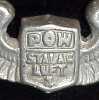
KASTAUFFER Posted January 16, 2009 #1 Posted January 16, 2009 The story of Patrol Wing Ten in the early days of WWII is a tale of determination and great loss. This Purple Heart I recently purchased illustrates one of the first combat actions of Patrol Wing 10, which was a failed bombing mission at Jolo, Philippines on December 27, 1941 The following is from this website : http://www.daveswarbirds.com/blackcat/hist-101.htm 27 Dec 1941: Six of the squadron’s PBY-4 Catalinas, led by Lieutenant Burden R. Hastings, conducted an early morning attack against Jolo, in the central Philippines. Enemy aircraft and AA fire broke up the formation before a bombing run could be made. Ensign Elwin L. Christman and his crew followed through alone and made a drop on an enemy vessel at 1,000 feet. The Catalina, heavily damaged by AA fire, caught fire. Three crewmen bailed out, but the others remained with the aircraft until Christman made a controlled water landing near shore. Three crewmen died; the others were eventually rescued. Aviation Machinist Mate’s First Class Andrew K. Waterman was the plane captain and waist gunner on the aircraft. He shot down one enemy aircraft while defending the Catalina during the attack on shipping in the harbor, but in doing so received mortal wounds. For his courageous actions under fire Waterman was posthumously awarded the Navy Cross. Radioman First Class Robert L. Pettit also stuck by his post even after the aircraft, flooded with aviation gas from perforated tanks, caught fire. For his devotion to duty Pettit was posthumously awarded the Navy Cross. Ensign Christman led the surviving members of his crew to safety on the shore of Jolo Island. Lieutenant Jack B. Dawley and the surviving members of his crew, who had also been shot down immediately after dropping their bombs, joined Christman’s group on Jolo Island. The two officers led their crews inland away from the Japanese, eventually reaching U.S. Naval Headquarters at Surabaya, Java, N.E.I. Aircraft Chief Machinist’s Mate Donald D. Lurvey was awarded the Navy Cross for assisting Ensign Cough, the second pilot of Dawley’s aircraft, into a life vest and guiding him to shore. Aviation Machinist’s Mate First Class Joseph Bangust received the Navy Cross posthumously for his action as waist gunner in Dawley’s aircraft, shooting down one enemy aircraft before being mortally wounded by incoming fire. Aviation Machinist’s Mate First Class Evren C. McLawhorn, the plane captain, took over the waist gun position after Bangust was mortally wounded. He received seven wounds during the fight, but survived and received the Navy Cross for his heroism. For their courage under fire and leadership in guiding their crews through enemy-occupied territory to safety, Ensign Christman and Lieutenant Dawley were awarded the Navy Cross. Lieutenant Hastings, as leader of the gallant but unsuccessful strike, was later awarded the Navy Cross for guiding the force into the target area in the face of overwhelming odds. Lieutenant Hastings’ award was made posthumously, as he and his men were the only aircrew captured by the Japanese. They were interrogated by their captors and beheaded on the parade ground of the Jolo garrison. The fourth Catalina shot down during the strike was manned by Lieutenant Hazelton and his crew. Hazelton made a sea landing and the entire crew safely escaped the sinking aircraft into life rafts and were picked up two days later by a squadron aircraft. RM1c Amon Wesley Gates lost his life on this mission. I am still doing some research to find out exactly which PBY he was a crewmember of. An extraodinary number of Navy Cross medals were awarded for this mission as indicated above. I have been collecting Posthumous US Navy Purple Hearts awarded to Naval Aviation personnel for quite a while and this is now the earliest example I own. The engraving style on this is the same as often seen on Pearl Harbor Purple Hearts, with the Rank and USN on the same line.
ADMIN Posted January 16, 2009 #2 Posted January 16, 2009 Excellent find!!!! Glad such a historical piece will be preserved and cared for now!
MWalsh Posted January 16, 2009 #3 Posted January 16, 2009 Nice one Kurt, saw that one for sale. Glad you got it! They actually had two PUC's for that short period between Dec. 8th and the time the Philippines fell? Assuming the ribbon belongs with the PH? That is a terribly sad period to study - terrible odds, little chance of success, little hope of actually making it out alive, the entire idea that they were all basically being abandoned... yet they carried on and did such as your original post notes. Amazing. MW
KASTAUFFER Posted January 16, 2009 Author #4 Posted January 16, 2009 Nice one Kurt, saw that one for sale. Glad you got it! They actually had two PUC's for that short period between Dec. 8th and the time the Philippines fell? Assuming the ribbon belongs with the PH? That is a terribly sad period to study - terrible odds, little chance of success, little hope of actually making it out alive, the entire idea that they were all basically being abandoned... yet they carried on and did such as your original post notes. Amazing. MW Thanks Mike! I was kinda glad he wasnt from Minnesota! I think the PUC came with the medal originally, and wasnt added by a collector. Thats my gut feeling. I am surprised no one came to the table and bid me up on this, but then again , I dont think anyone knew what the action it was awarded for either. The unit and action wasnt described as part of the auction and " Google " would not have been any help to anyone on this piece , or ABMC ETC . This was a case of where " good old time research " beat the power of the internet . Kurt
Jim Baker Posted January 16, 2009 #5 Posted January 16, 2009 Kurt, Very glad this worked out so well for you. What an extraordinary find. Great things are still out there!!
Salvage Sailor Posted January 16, 2009 #6 Posted January 16, 2009 The story of PATWING TEN and 'the Lonely Ships' of the Asiatic Fleet in early 1942 will always be highly regarded among the great sea sagas of the Pacific War.
TBMflyer Posted January 16, 2009 #7 Posted January 16, 2009 Kurt, try to find the book "IN THE HANDS OF FATE" by Dwight Messimer. It is the story of PatWing 10 from 12-8-41 thru 5-11-42. It is a well researched book with some neat photos. Mark
disneydave Posted January 16, 2009 #8 Posted January 16, 2009 Several copies for sale here in the $10 range: http://www.bookfinder.com Cheers! David
KASTAUFFER Posted January 16, 2009 Author #9 Posted January 16, 2009 The book has now been ordered Kurt
teufelhunde.ret Posted January 16, 2009 #10 Posted January 16, 2009 Good for you Kurt - cannot recall that many Crosses being awarded to one flight crew. Thanks for sharing with us! s/f Darrell
Moonlight Gecko Posted January 23, 2009 #12 Posted January 23, 2009 WOW! Great medal with A LOT of history.
KASTAUFFER Posted May 11, 2009 Author #13 Posted May 11, 2009 Gates was recommended for an Air Medal, but it was denied. After reading the reccommendation its makes you wonder what a fella had to do to earn one in the US Navy!
Guest USS GOLD STAR Posted July 3, 2011 #14 Posted July 3, 2011 Patrol Wing TEN's raid on Jolo Island in the Philippines on 27 December 1941, was mounted from Ambon, in the NE. Six PBY-4 Catalina flying boats took off, they were intercepted by Japanese fighters over the island, and only two returned. Patty officer Gates was in the lead plane, 101-P-1. Here are the crew members, reconstructed from several Wing and squadron documents: First Section 26-27 December 1941 – PBY-4 101-P-1 ( BuNo. 1237) Commander LT Burden R. “Barney” Hastings, USN PPC Ensign Russell F. Chambers, USNR second pilot Ensign Marsh V. Miller, USNR third pilot AMM1c (NAP) Clyde E. Evans, USN Plane Captain ACMM Louis E. Erreca, USN first radio CRM Clyde C. Parks, USN first mech AMM3c Paul R. Moses, USN second radio RM1c Amon W. Gates, USN There is more to the story than Messimer could find at the time. If you want more, email me. USS GOLD STAR
Guest sherrye Posted June 24, 2013 #15 Posted June 24, 2013 The medal is beautiful! Amon Wesley Gates was my Great Uncle. My son, Wesley, is the 4th generation with the name "Wesley" in honor of him. Is it possible for me to get a better picture of his medal then just copying from this forum? I am making a scrapbook for my son about each family member that he is named for. Thanks!
KASTAUFFER Posted June 24, 2013 Author #16 Posted June 24, 2013 Hi Sherrye The picture on the forum is the very best one I have. I am glad you found the posting! Thanks Kurt
JDK Posted June 24, 2013 #17 Posted June 24, 2013 Missed this one the first time around. What a fantastic heart. Thanks for posting and paying tribute to this airman! JD
Jack's Son Posted June 24, 2013 #18 Posted June 24, 2013 Nice to hear from a family member. I hope all of the information on this thread will be helpful to her!
kanemono Posted June 24, 2013 #19 Posted June 24, 2013 This is the first time I saw this post. Great medal and research Kurt. The research with the medal keeps his memory alive for future generations. Dick
Guest sherrye Posted June 24, 2013 #20 Posted June 24, 2013 Thanks for honoring Amon! Here is the paper we have that goes with his purple heart.

Recommended Posts
Create an account or sign in to comment
You need to be a member in order to leave a comment
Create an account
Sign up for a new account in our community. It's easy!
Register a new accountSign in
Already have an account? Sign in here.
Sign In Now