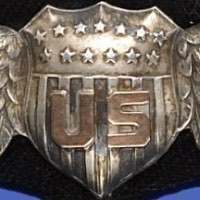
October 22, 20205 yr #1 World War One Weekly Wing #43 American-Made, Unknown Maker Wingnuts, Still catching up. In the meantime, here is another nice WW1 wing of which, unfortunately, little to no information has surfaced. This bold and elegantly handsome wing has been a tough nut to research. Apparently a fairly scarce wing, it is sometimes called a "solid-type" Shreeve by collectors due to its superficial design resemblance to wings made by that firm. Shreeve and Co. of San Francisco however was fairly consistent about marking their wares and every example of this badge encountered is only marked sterling. Consequently, I remain unsure if there is a connection between this badge and Shreeve and Co. Although given the obvious similarity, clearly one of the two badges inspired the other. The badge itself is very heavily die struck in three pieces with the two wings silver soldered to the central shield. The badge also exhibits perhaps the largest separately applied gold gothic US of any WW1 badge. A thick, tapered pin and oversized drop in catch with pin-tip protector round out the badge.
October 22, 20205 yr #2 Chris, have all of the wings in this design you have seen had these heavy pins and catch?
October 22, 20205 yr #3 Looks like Hercules findings. I love these Chris!Sent from my iPhone using Tapatalk
June 18Jun 18 #4 Recently acquired one of the unique Shreeve-style wings. In conferring with @cwnorma, there are not many examples known and the information @cwnorma provided in 2020 is still all that is known on this pattern.
June 18Jun 18 #5 For what it is worth, I thought it may be informative / helpful to provide a side-by-side comparison of the Shreeve and the Shreeve-style wing. On top is the Shreeve-style wing and measures at 3 1/4”; the Shreeve measures at 3 7/16”.
June 19Jun 19 Author #6 3 hours ago, guerrap said: I love this image! Very artistic! Nice wing and nice work finding one Pete! Warm regards! Chris
June 19Jun 19 #7 Even though I am just a lurker on these posts on these WWI wings I have to come out and say that they are some of the most beautiful items in the US Militaria. I love looking at the details that went into these early wings. The fine feather details, the different types of shields, and the stars cut into them are what make these truly works of art IMO. While I am not a wing collector at all, I have to say that these wings that pop up on these posts from time to time are really extraordinary and a pleasure to the eyes to look at and study the details. Just wanted to give you all a shout out for posting a little eye candy for this non-wing guy to view on this platform. Keep up the great work, and keep posting these amazing pieces of military history. The TR badges (pilot/RO/FJ) wings have NOTHING on these outstanding wings.
June 20Jun 20 #8 Is there any evidence that these two wings weren't made by Shreeve? Other than the lack of a hallmark and some rather subtle differences, its hard to imagine these two badges coming from different sources. I kind of always figured that over time, the complexity of making the Shreeve & Co.-marked wing as a hollow multi-piece construct was simplified into a couple/three die struck parts soldered together. My research into Shreeve suggests that they were pretty careful to design and sell their own stuff in their own shops, and it seems counterintuitive that another company would be allowed to make a "knock off" Shreeve design for sale. P
June 20Jun 20 Author #9 12 hours ago, pfrost said: Is there any evidence that these two wings weren't made by Shreeve? None that I've ever been able to find. But, the reciprocal is true as well. Clearly though, with respect to WW1 wings there was both copying of designs between competing firms (see: Dallas wings) and evolutionary change within lines (see: Simmang). As to Shreeve defending its Intellectual Property, the United States was a very different landscape in 1918. The badges themselves were only worn for a brief 18 months. My current theory (based admittedly on extremely limited [and mostly anecdotal] information is the solid version was a direct copy of the Shreve made by one of the Los Angeles based makers. If that tenuous theory holds, unless a cognizant employee decided to take the train down to LA from SF to check out the competition, how would Shreve have even known? Moreover, even if SF-based Shreve was aware of the copies, could they have mounted an IP challenge before the Adams wings hit the scene in 1919? (see Dallas wing patent fight) Besides all the physical differences possibly arguing for separate makers; the hollow version almost always is found bearing Shreve's hallmark. To date, none of the solid versions has surfaced with such a mark. Probative? Absence of evidence is not evidence. Adding to the challenge is that both the Shreve-marked hollow badge and the sterling marked solid badge are both so scarce that it is maddeningly challenging to find any information on either. Shreve is known to have made two WW1 era wing badges: 1) 1918 US Army Air Service Reserve Military Aviator, & 2) 1919 Philippine Air Service Aviator (phenomenally rare). Both 1) and 2) share Shreve's hollow construction and Hallmarks. The 3) solid badge remains an interesting, unresolved mystery: Ultimately all are different enough that every collector should strive to have one of each! Warm Regards! Chris
June 22Jun 22 #10 Just one of each? That's for chumps and newbies. You need at least 8. One that was polished by the original owner, one that was never polished at all, one that is pin-back, one that is screw-back, one more just in case you lose one, one to pin on a uniform that you can display at ASMIC, one for your metal WWI wing display case, and then one to brandish at your buddy. That is, of course, the bare minimum. One of each is just too darn mundane. As we have talked about before, are you a LUMPER or a SPLITTER? P


Create an account or sign in to comment