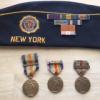
JakeBird6684 Posted February 23, 2020 #1 Posted February 23, 2020 Hey all, I picked up this really amazing group of uniforms to a Vice admiral in WW2, he also served in WWI as an areo squad pilot. I have had a troubled time researching him and was wondering if the forum could Help. All I was able to find on him was his find a grave obituary and a lot on his son who won the navy cross in wwii as well. Please help out in anyway that you can, its hard to image that a sailor who sailed in 11 pacific battles would have so little information about him online. If I have to pay some company to get some research on him, I would love too! These uniforms are HEAVLY moth eaten and as a the story goes, were found in a wooden box in the loft of a barn that was his wifes brothers or something like that. The person who originally bout the group, searched the entire estate and wasnt able to find much else. Any info and research help would be greatly appreciated. I hope everyone had a spectacular SOS this year. I know I did!! Thanks, Jake Bird
JakeBird6684 Posted February 23, 2020 Author #3 Posted February 23, 2020 The missing item on the bronze star is supposed to be a V for valor, and the large star on the asiatic pacific campaign ribbon is supposed to be gold to signify 10 campaigns.
JakeBird6684 Posted February 23, 2020 Author #4 Posted February 23, 2020 Also forgot to mention that all of the corresponding pants were included as well.
Roderick Read Posted December 7, 2024 #5 Posted December 7, 2024 VADM Willaim Augustus “Gus” Read’ father ran the Wall St. firm of Dillon Read & Co, and he had several siblings. His twin brother, Curtis S. Read (Naval aviator #83, and the first American killed in a floatplane training accident just before the US entered WWI on February 26, 1918. Two other brother’s Duncan H. Read and Russelk B. Read were also Naval aviators. “Gus” earned his wings of gold on Armistace Day, November 18th, 1918. He was late joining the Navy because he started in General Washington’s first regiment - obviously long after Washington died - as a reservist after his first or second year at Harvard. He managed a team of horses, Bruno and Bliss, and took them via train down to El Paso, TX as part of the Spanish American campaign, and was hoping to eliminate Pancho Villa. When the troops retuned east, Gus expected to receive his commission in the Army. After nine months of waiting, the Army suggested he enlist. Gus said no, as his brothers were ensigns in the Navy. Gus joined the Navy just as his Army commission came in, but various discussions between the Army and Navy got everything cleared up, and he stayed with the Navy. A 800+ page Columbia University from November 1964, contains all the incredible details about his Navy career, but is only available to family members, and not allowed to be published.
atb Posted December 7, 2024 #6 Posted December 7, 2024 What is "General Washington's first regiment?" How does Pancho Villa (1916) relate to the "Spanish American campaign (1898)?"
R Leonard Posted January 29, 2025 #7 Posted January 29, 2025 From the “Early and Pioneer Naval Aviators Association Chronolog, ‘The Golden Eagles’” pgs 1055-1056. https://www.epnaao.com/Chronolog/2018 Chronolog.pdf William Augustus Read was born in Rye, New York, on August 21, 1895, son of William Augustus and Caroline Hicks (Seaman) Read. He was graduated from the Pomfret School, Pomfret, Connecticut, in 1913 and entered Harvard College, Cambridge, Massachusetts, as a member of the Class of 1918. In 1914 he joined Battery A, First Massachusetts Field Artillery, and served as a Private, First Class, on the Mexican Border. He was honorably discharged in November 1916, and on November 3, 1917, enlisted in the U. S. Naval Reserve Force for World War I service Called to active duty early in 1918, he had flight training at the Naval Air Station, Pensacola, Florida, and was commissioned Ensign on July 22, 1918, and designated Naval Aviator #1366 in July of that year. He had aerial gunnery training at Taliaferro Field, Fort Worth, Texas, and was assigned to the Aviation Section of the Office of Naval Operations, Navy Department, Washington, D. C., before the signing of the Armistice on November 11, 1918, and was relieved of active duty on November 30, that year. He resigned from the U. S. Naval Reserve Force on July 28, 1919. In civil life he was a member of the firm of Dillon, Read and Company from 1919 to 1929, and during the period 1930 to 1940 was a Vice President of the Central Hanover Bank and Trust Company. He was in charge of the Personal Trust Department of that bank from 1932 to 1940. In 1933 he became a member of the Executive Committee of the Corporate Fiduciaries Association, serving as such until 1940, and also was a member of the Executive Committee Trust Companies Association, its President in 1938-1939. He accepted an assignment to active duty in the U. S. Naval Reserve in July 1940, and resigned from the Central Hanover Batik on November 1, 1940, to continue on duty in the Bureau of Aeronautics. Commissioned Lieutenant Commander in the Naval Reserve on May 4, 1930, he was promoted to the rank of Commander on January 9, 1941, to Captain on September 17, 1943, and to Commodore on November 2, 1945. His nomination for the rank of Rear Admiral was confirmed by the Senate on September 17, 1953. On July 23, 1940 he reported for duty in the Bureau of Aeronautics, Navy Department, Washington, D. C., and in September 1942 was ordered to Pearl Harbor, T. H., for duty as Aide and Flag Secretary on the staff of Commander Air Force, Pacific Fleet (Vice Admiral John H. Towers, USN). He was awarded the Legion of Merit and cited “For exceptionally meritorious conduct...as Flag Secretary on the Staff of Commander Air Force, U. S. Pacific Fleet, from November 1942 to March 1943, and as Officer in Charge of Advanced Bases from September to November 1943. The citation states further: “By his exceptional skill in supervising the multitude of complex details Involved in discharging his secretarial and legal functions (he) rendered invaluable assistance in the efficient administration of the command..." In March 1943 he joined the staff of Commander Fleet Air Noumea (the late Admiral Marc A. Mitscher, USN), going on, as Assistant Chief of Staff for Administration, to Guadalcanal, when the Admiral became Commander Air, Solomons Islands on April 1, 1943. Upon completion of this duty on July 25, 1943, he was awarded a commendation by Commander South Pacific Area and South Pacific Force with a citation reading in part: “For...carrying out important duties under difficult conditions, including frequent large scale enemy air attacks. His duties also included flights to outlying islands within the sphere of enemy control as the representative of Commander Air, Solomons Islands, for the purpose of rescuing stranded American flight personnel....” In June 1944 he joined the staff of Commander First Carrier Task Force, Pacific (the late Admiral Marc A. Mitscher, USN). He was awarded the Bronze Star Medal and a Gold Star in lieu of the Second Bronze Star Medal, each with Combat “V,” and citations, following in part: Bronze Star Medal: “For meritorious service as Awards Officer on the Staff of the Commander of the First Carrier Task Force, during action against enemy Japanese forces in the vicinity of the Marianas, Carolines, Bonins, Halmahera, Philippines, Formosa and the Nansei Shoto, from June through October 1944. Discharging his duties with great professional skill and efficiency, Captain Read aided in the support of amphibious landings, thereby contributing to the success of many hazardous mission...” Gold Star in lieu of Second Bronze Star Medal: “For meritorious service as Logistics Officer and Staff Watch Officer on the staff of Commander FIRST Carrier Task Force, Pacific, in action against enemy Japanese forces, from December 1944 to May 1945. Serving with distinction throughout this period, (he) contributed materially to the success of our operations against Tokyo, Iwo Jima, Kyushu, Kure Naval Base Okinawa and major units of the Japanese fleet, on April 7, 1945. Although his ship was hit by enemy aircraft on two occasions he continued to carry out his assignment in an outstanding manner..,” Returning to the United States in the summer of 1945, he again served under Admiral Mitscher, then Deputy Chief of Naval Operations (Air), Navy Department. He was released from active duty on October 12, 1945, was confirmed in the rank of Commodore on November 2, that year, and a few days later was recalled for temporary duty with the Commandant, Third Naval District, New York, New York. In addition to the Legion of Merit, the Bronze Star Medal with Gold Star and Combat “V,” and the Commendation Ribbon, Rear Admiral Read has the Mexican Service Medal; the World War I Victory Medal, Aviation Clasp; the Presidential Unit citation with two stars; the Navy Unit Commendation; American Defense Service Medal; the American Campaign Medal; the Asiatic-Pacific Campaign Medal; the World War II Victory Medal; and the Philippine Liberation Ribbon with one star. William Augustus Read retired from the Navy in September 1957. His promotion to Vice Admiral came as an advancement on the retired list by reason of combat citation pursuant to Title 10, U.S. Code, Section 6150 (Repealed 1 November 1959); what is known in the vernacular as a “tombstone promotion.” His retirement was under the provisions of Title 10 USC 1331, which as a regular officer serving in WW2 with less than 20 years regular service by with sufficient previous reserve service entitled him to retirement pay on the basis of his highest active duty rank. By 1957 Read will have reached the statutory retirement age by the next fiscal year.
Recommended Posts
Create an account or sign in to comment
You need to be a member in order to leave a comment
Create an account
Sign up for a new account in our community. It's easy!
Register a new accountSign in
Already have an account? Sign in here.
Sign In Now