
Edited by Josh B., 27 December 2010 - 08:18 PM.
WWII Navy jumper set with gun pointer first class striker
#1
Posted 27 December 2010 - 08:17 PM
#2
Posted 27 December 2010 - 08:19 PM
#4
Posted 28 December 2010 - 12:09 PM
#5
Posted 28 December 2010 - 12:12 PM
Especially with the Battleship Massachusetts docked not to far in Fall River, Mass..
PS
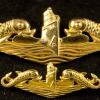
I still have those sub covers set aside for you, when I get a chance I'll snap some pics..
Leigh...
#6
Posted 28 December 2010 - 02:54 PM
Been there five times and have another visit planned for the Spring!!!!
#7
Posted 28 December 2010 - 04:15 PM
Nice navy grouping! Is the jumper tailor made? :thumbsup:
Jason
#8
Posted 28 December 2010 - 04:18 PM
Josh,
Nice navy grouping! Is the jumper tailor made? :thumbsup:
Jason
Jason,
Thanks! From the quality of the wool, lack of a standard label under the neck flap, etc I'd say that it must be, but unfortunately there are no tags in the jumper or pants.
Josh
#9
Posted 28 December 2010 - 04:29 PM
Jason,
Thanks! From the quality of the wool, lack of a standard label under the neck flap, etc I'd say that it must be, but unfortunately there are no tags in the jumper or pants.
Josh
Josh,
From the picture it looks like the jumper has the silk lining inside the jumper, if so it's definitely tailor made. It's a really nice piece and a family connection just makes it more special.
Jason
Edited by navyman, 28 December 2010 - 04:33 PM.
#10
Posted 29 December 2010 - 08:48 AM
#11
Posted 29 December 2010 - 10:03 AM
I'm not a Navy man, so forgive my ignorance, but what does the white stripe on the right shoulder signify? And is that rank on the left arm? Very cool uniform, my grandfather was a submariner in WWII and one of my goals is to recreate his uniform someday. First I'll have to learn a thing or two!
The shoulder seam stripe was a "branch mark" which indicated non-rated (below petty officer) men. Men of the seaman branch wore a mark around the right shoulder, white on blue and vice versa. Men of the engine room force (firemen) wore a red mark on the left side on both blue and white uniforms. Hospital apprentices, musicians, stewards' mates and a couple other specialists I can't recall did not wear a branch mark.
At that time, the white stripes on the cuff of the dress jumper were not just decorative but indicated the grade for non-rated men: One stripe for apprentice seaman/fireman 3rd class, two for seaman/fireman 2c, and three for seaman/fireman 1c. This example is a seaman 1st class. Undress blue and white jumpers, which had the sleeves hemmed off square with no cuffs, showed the branch mark but not the cuff stripes. The dress white jumper with striped blue collar and cuffs was elimiinated shortly before WW2.
Upon becoming a petty officer the "crow" rating badge would be worn and the shoulder branch mark would be removed. Insignia for non-rated personnel was changed to the short diagonal sleeve stripes in 1948, which originated with the WAVES in WW2.
Edit to add: The insignia on the left sleeve is a "distinguishing mark," which in this case indicated qualification as a Gun POinter 1st Class, which was in addition to the man's basic rate.
Sorry I can't summarize shorter than that!
Best regards,
Justin B.
Edited by Justin B., 29 December 2010 - 10:16 AM.
#12
Posted 29 December 2010 - 12:37 PM
#13
Posted 29 December 2010 - 07:33 PM
Good explanation, thanks! My g'pa was an EM2c (T). He always said he was an electrician on a submarine, so I'm assuming the EM is electrician's mate. Any idea what the "(T)" was? Thanks for your help!
You're right, electrician's mate 2nd class. The "T" indicated a temporary appointment. Basically, a promotion made by "local" command authority rather than through the Bureau of Personnel in Washington, which was not guaranteed to be permanent. Very common in wartime.
Best regards,
Justin B.
#14
Posted 30 December 2010 - 01:48 PM
Ah, that explains it. Thanks a lot for your help!You're right, electrician's mate 2nd class. The "T" indicated a temporary appointment. Basically, a promotion made by "local" command authority rather than through the Bureau of Personnel in Washington, which was not guaranteed to be permanent. Very common in wartime.
Best regards,
Justin B.
0 user(s) are reading this topic
0 members, 0 guests, 0 anonymous users


